Importing Korean Vehicles Into Angola: The Age Limit That Closes Most Auction Stock
Angola drives on the right, which makes left-hand-drive Korean auction stock mechanically and legally registrable — the structural blocker that shuts Korean supply out of Kenya, Tanzania, Uganda, Zambia and the southern right-hand-drive belt does not apply here.
Angola instead applies a different filter, and it is sharper: one of the tightest used-vehicle age limits on the continent.
For an operator whose Korean supply is concentrated in four-to-eight-year-old units, that filter removes most of the inventory before any other consideration matters.
The short version
- Angola restricts the import of used light passenger vehicles above a low age threshold, and the threshold is measured in years rather than by emissions standard or mileage.
- Angola’s customs administration is the Administração Geral Tributária (AGT), which absorbed the former customs service.
- Angola’s import trade is shaped by access to hard currency.
- The Port of Luanda handles the bulk of Angola’s vehicle imports and is the default discharge point for units destined for the capital and the coastal market.
What is Angola’s vehicle age limit?
Angola restricts the import of used light passenger vehicles above a low age threshold, and the threshold is measured in years rather than by emissions standard or mileage. The commonly cited figure for light passenger vehicles is three years, with different treatment for commercial and heavy categories.
Because Angola has revised its vehicle import framework more than once and the treatment differs by category, confirm the current position against the Pauta Aduaneira and the applicable presidential decree before committing capital — an agent quoting an older rule is quoting a rule that will be applied against the current one at Luanda.
The consequence for Korean sourcing is direct. The units that make Korean export supply attractive to African buyers — a Tucson NX4 or Sportage NQ5 with moderate mileage and a clean grade, four to six years old — sit outside a three-year window.
What sits inside it is nearly new stock, where the Korean domestic price advantage is much thinner and the competition from official distributor channels is real.
There are two workable responses. Either target the commercial and heavy categories, where age treatment is generally more permissive, or accept that Angola is a market for near-new units and price accordingly. What does not work is buying ordinary auction stock and hoping the rule is enforced loosely.
What does AGT require to clear a vehicle in Angola?
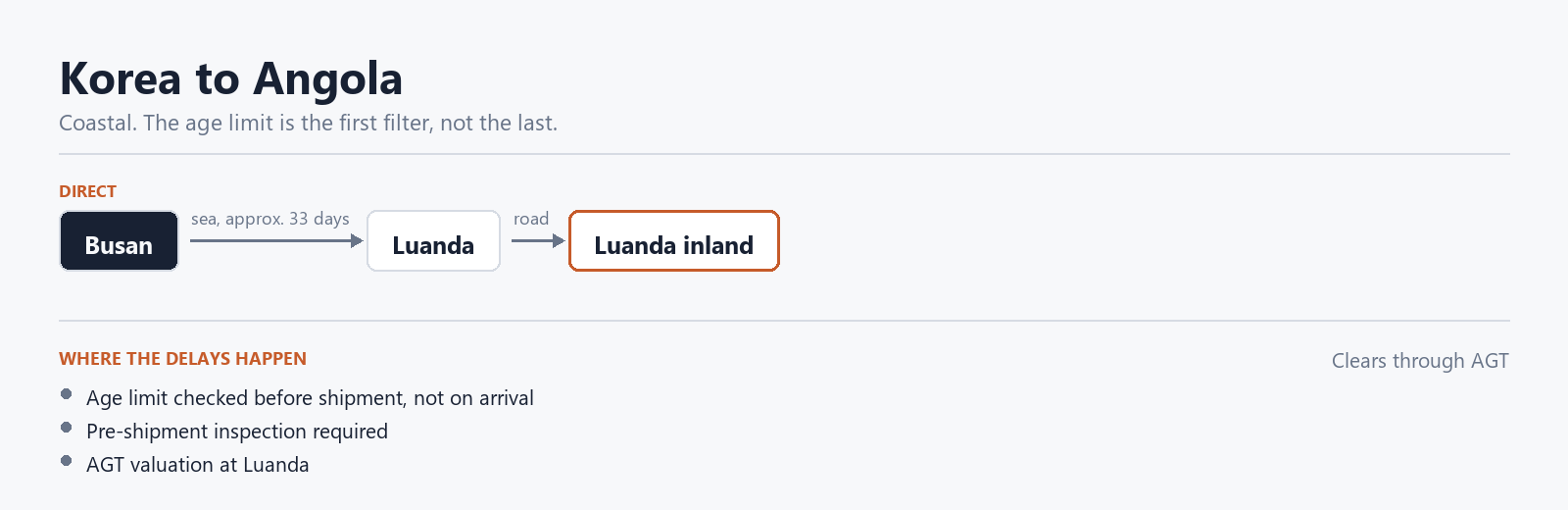
Angola’s customs administration is the Administração Geral Tributária (AGT), which absorbed the former customs service. The clearance stack an importer deals with:
- Import licensing — commercial vehicle imports run through a licence application; the licence is checked at declaration and a shipment that sails without one creates a problem that is resolved at the importer’s cost.
- Declaration and assessment — AGT assesses on CIF value with duty per the tariff schedule, consumption tax, and the applicable stamp and service charges. Vehicles carry their own tariff and excise treatment by displacement and category.
- Pre-shipment documentation — the commercial invoice, bill of lading, certificate of origin and the Korean export deregistration certificate form the core set. As elsewhere in the region, chassis number consistency across all of them is what keeps the file moving.
Why is foreign exchange the real constraint in Angola?
Angola’s import trade is shaped by access to hard currency. Payment for imports moves through the commercial banking system under Banco Nacional de Angola rules, and the availability and timing of an allocation is a live variable rather than a background one.
An importer who has agreed a delivery schedule with a Korean-side supplier on the assumption that payment clears promptly is exposed to a queue they do not control.
The practical mitigations are the ordinary ones and they matter more here than in most markets: stage payments against shipment milestones rather than paying in full up front, build the FX timeline into the delivery commitment you give your own buyer, and never let a vessel sail against a payment that has been promised but not executed.
Should you clear at Luanda or Lobito?
The Port of Luanda handles the bulk of Angola’s vehicle imports and is the default discharge point for units destined for the capital and the coastal market.
Lobito is the second major port and is the sea end of the Lobito Corridor — the rail route running inland towards the Copperbelt and the Katanga side of the Democratic Republic of Congo. Namibe serves the south.
For an operator thinking beyond Angola itself, Lobito matters. The corridor’s redevelopment reorients part of the region’s inland freight towards the Angolan coast, and a discharge at Lobito with onward transit is a different economic proposition from a discharge at Luanda for domestic sale.
Transit cargo is not subject to Angolan registration requirements, which means Angola’s age limit does not bind on units that are passing through — a distinction worth understanding precisely before assuming the age rule closes the country entirely.
The check that saves the shipment
Before a deposit moves on any Angolan-destined unit, three things need to be established in writing:
- Model year and first registration date from the Korean record, not from the listing description. Age rules are applied against a documented date, and the two are not always the same thing.
- Category classification — passenger, commercial or heavy determines which age treatment applies, and the classification follows the vehicle’s construction and the tariff heading, not the seller’s description of it.
- Chassis number, matched across the proforma invoice, the export deregistration certificate and the bill of lading.
Angola is a real market for Korean vehicles. It is not a market for the part of the Korean auction pool that most exporters are set up to sell, and the difference between those two statements is the whole business case.
Sourcing Korean stock for your next container? Tell us the destination port, the model year you are targeting and the spec, and we come back with matched units and a landed figure per unit. Start at SK AutoSphere, or browse the parts catalogue.