How to Clear a Korean Used Vehicle Through Tema Port, Ghana — Operator’s Guide
Sourcing a used Hyundai Tucson or Kia Carnival from a Korean auction is the easy part.
Getting it released from Tema Port — Ghana’s principal gateway for Korean vehicle imports — is where first-time importers consistently lose money: demurrage, classification disputes, ICUMS valuation surprises, and rejected documentation all stack up before a single wheel turns on Ghanaian tarmac.
This guide walks through the actual clearance sequence at Tema, based on how Korean vehicle exports currently move through the Ghana Revenue Authority (GRA) Customs Division process as of 2025.
The short version
- Ghana’s Motor Traffic and Transport Department (MTTD) enforces a 10-year maximum age restriction on imported passenger vehicles.
- Incomplete documentation is the single biggest cause of avoidable demurrage at Tema.
- Ghana applies the ECOWAS Common External Tariff (CET) to vehicle imports.
- Ghana’s Integrated Customs Management System (ICUMS), run by Ghana Link Network Services (GLNS), handles all import declarations and payment.
The 10-Year Age Limit: Verify Before You Buy
Ghana’s Motor Traffic and Transport Department (MTTD) enforces a 10-year maximum age restriction on imported passenger vehicles. A 2013 Hyundai Santa Fe can still be imported in 2025 (12-year-old vehicle — it cannot). The cutoff is by model year, not manufacture date.
Practical consequence: when browsing Korean auction listings on the Korean domestic listing market, filter immediately to 2015 or newer if you want a clean import with no age-restriction fight. Vehicles from 2014 routinely slip through on older listings — and the GRA at Tema will enforce the restriction during valuation.
Parts imports are not subject to this rule. A 2009 Kia Sportage engine or gearbox clears through a different HS tariff chapter (HS 8407/8408/8708) with no age check.
Your Document Checklist (Compile Before the Vessel Sails)
Incomplete documentation is the single biggest cause of avoidable demurrage at Tema. Prepare the following in parallel with the vessel booking — not after:
| Document | Issued by | Common failure mode |
|---|---|---|
| Bill of Lading (OBL or Sea Waybill) | Shipping line (a manufacturer-run auction house, EUKOR, Grimaldi, Höegh) | Chassis number typo versus Korean Export Certificate |
| Korean Export Certificate | Korean Customs (Korea Customs Service) | Missing — many auction-house reps don’t include it automatically |
| Invoice / Purchase Agreement | Korean dealer or auction house | Under-declared CIF value triggers GRA revaluation |
| Packing List | Exporter | Required even for a single vehicle on RoRo |
| PVOC / Pre-Export Verification of Conformity | Intertek or Bureau Veritas, pre-shipment | Mandatory for Ghana since 2013; must be done before loading |
| Insurance Certificate | Ghanaian insurer (must be local) | Often forgotten until Tema — can delay release 2–3 days |
| Form C-32 (Import Declaration) | Filed via ICUMS | Errors here trigger a manual verification hold |
The PVOC Requirement in Practice
Ghana’s Pre-Export Verification of Conformity (PVOC) program — administered through Intertek (GhanaLink) and Bureau Veritas — requires that vehicles are inspected in Korea before loading. The certificate must cover roadworthiness, HS code classification, and CIF value.
Without a valid PVOC, the vehicle goes into a GRA examination queue at Tema that adds 5–10 working days and a possible penalty surcharge.
For vehicles purchased directly from Korean dealers (e.g. via the export-facing aggregators’s dealer listings or direct dealer contact), arrange PVOC inspection at the seller’s yard in Incheon or Busan 3–5 days before the vessel cutoff.
Auction-sourced vehicles run through the auction’s pre-export lane at the a manufacturer-run auction house Pyeongtaek RoRo terminal — confirm with the auction agent that the PVOC certificate is included in the lot.
Duty Structure: What You Actually Owe at Tema
Ghana applies the ECOWAS Common External Tariff (CET) to vehicle imports. The effective rate for a used passenger vehicle (HS 8703) is:
| Charge | Rate | Applied to |
|---|---|---|
| Import Duty | 20% | CIF value |
| VAT | 15% | CIF + duty |
| NHIL (National Health Insurance Levy) | 2.5% | CIF + duty |
| GETFund Levy | 2.5% | CIF + duty |
| ECOWAS Levy | 0.5% | CIF value |
| EXIM Levy | 0.5% | CIF value |
| Effective combined rate | ~49–55% | Depending on GRA’s reference value |
The GRA’s reference value, not your invoice price, is what matters. The GRA uses the CRRI (Customs Reference Rate and Revenue Improvement) system — a database of CIF values for common Korean makes/models/years.
If your Kia Sorento 2019 was auctioned at KRW 12.5M but the CRRI benchmark for that spec is KRW 16M, duty is calculated on the higher figure.
Practical implication: don’t build a landed-cost estimate from the auction hammer price. Use the CRRI benchmark as your floor for duty calculation. GRA customs officers at Tema will use it.
The ICUMS Clearance Sequence
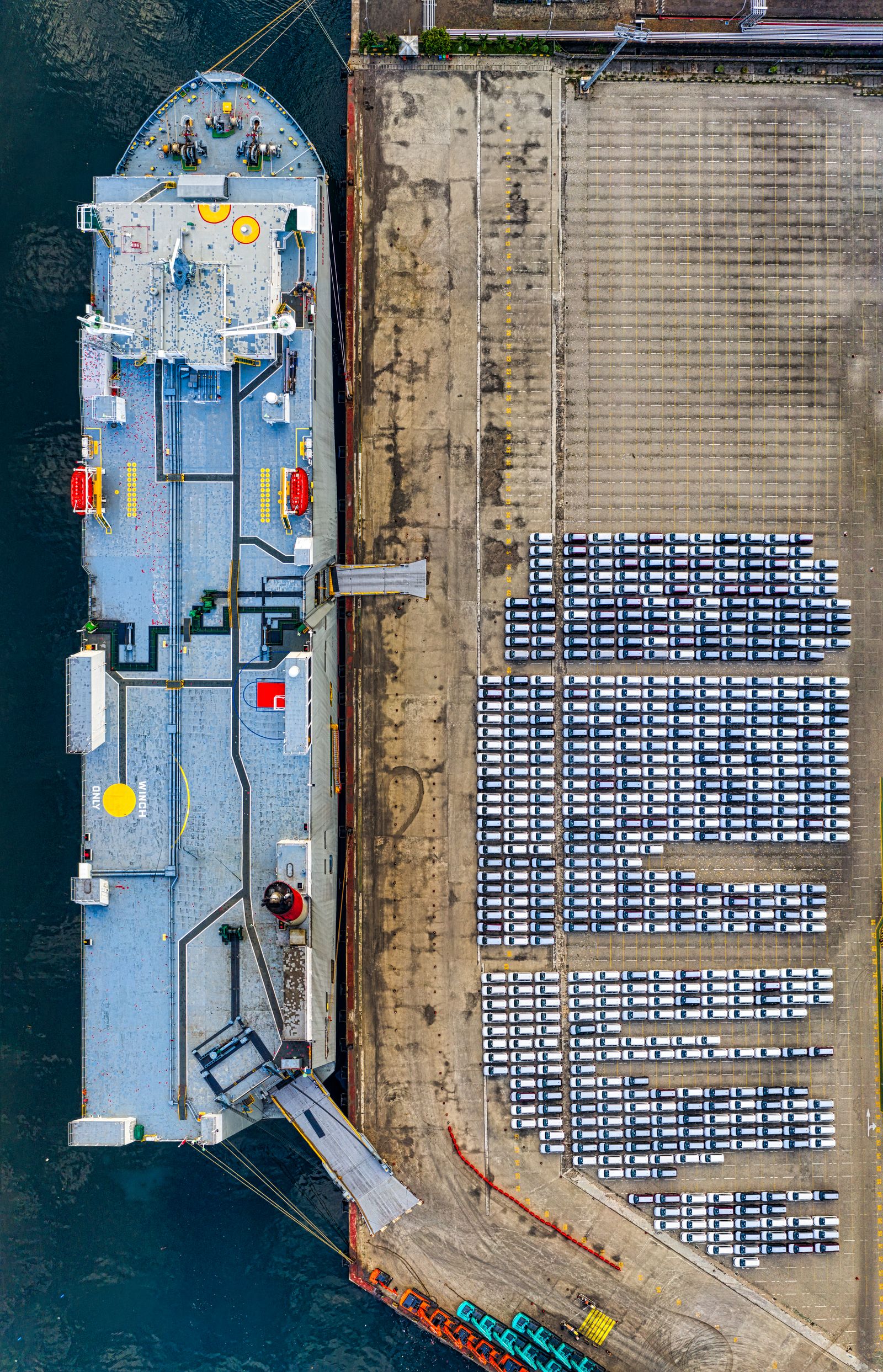
Ghana’s Integrated Customs Management System (ICUMS), run by Ghana Link Network Services (GLNS), handles all import declarations and payment. The sequence after your vessel arrives at Tema:
Step 1 — Pre-arrival: File Form C-32 via ICUMS through a licensed clearing agent (Tema Clearing & Forwarding Agents Association members or equivalent). Do this 5–7 days before vessel ETA to get a GRA assessment before the vessel berths.
Step 2 — GRA Assessment: ICUMS generates an assessment notice. Pay online (GRA’s e-payment portal) or via designated banks. No cash accepted at the port.
Step 3 — Documentary verification (Green/Yellow/Red channel):
– Green: documentation checks out; proceed to port release.
– Yellow: documents held for manual desk review (1–2 additional days).
– Red: physical examination of the vehicle by GRA examiner at the yard. Triggered by valuation disputes, PVOC anomalies, or chassis number flags.
Step 4 — Port release and SGS inspection: After GRA release, Ghana’s SGS-BIVAC vehicle inspection (roadworthiness check, chassis number verification against Bill of Lading) runs in the Tema container/RoRo yard. Clearance includes obtaining the GRA Release Order and SGS clearance sticker.
Step 5 — Port Authority charges: Tema Port Authority levies berth dues, port levy, stevedoring, and storage charges that accumulate daily if you haven’t pre-arranged release. For RoRo vehicles, Meridian Port Services (MPS) — the Tema terminal concessionaire — handles the final handoff.
Budget GHS 1,500–3,500 (approx. $100–240 at mid-2025 rates) in port authority charges per vehicle, separate from duties.
Free Days and Demurrage — Where Importers Lose Money
RoRo vessels at Tema typically grant 5–7 free days before storage charges start accruing. Container imports: 3–5 free days depending on the line.
If ICUMS declares a Red channel examination, add 3–5 days to your clearance timeline. If it overlaps with a weekend or public holiday (Tema offices close for Ghanaian public holidays, including Farmer’s Day, Independence Day, Republic Day), free days do not pause. The clock runs.
Operators who avoid demurrage reliably do three things:
1. File the ICUMS declaration 5+ days before vessel arrival (not after).
2. Pre-clear payment: have funds in the GRA e-payment system before the ship docks.
3.
Brief the clearing agent on chassis number discrepancy risk (common with Japanese-spec re-exports that pass through Korea) and resolve it before departure, not at Tema.
Lagos (Apapa/Tin Can) vs. Tema: The Routing Decision
If your buyers span both Ghana and Nigeria, the port routing decision is largely made by import restrictions, not preference:
- Nigeria’s NCS applies a 35% import duty on vehicles under HS 8703, versus Ghana’s 20%. For the same 2020 Hyundai Santa Fe, landed cost in Lagos is typically 15–18% higher than Tema before local transport.
- Nigeria bans importation of used vehicles older than 15 years (previously 5 years — was relaxed). Check current NCS Customs Public Notice before each order.
- Tema’s advantage: Ghana has a better-developed clearing ecosystem for Korean RoRo vessels. a manufacturer-run auction house and EUKOR both call Tema as a primary West African hub, so vessel frequency is higher.
- Lagos advantage: the Ladipo and Abossey Okai spare-parts markets are the largest in West Africa. If you’re importing Korean parts alongside vehicles, Lagos has a deeper secondary market to absorb parts inventory quickly.
What to Ask Your Korean Dealer Before Paying
- Does the purchase price include PVOC arrangement? If not, who coordinates with Intertek/BV and at what cost?
- What chassis number appears on the Korean Customs export manifest? Must match the vehicle plate. Verify it against the auction inspection sheet before payment.
- Is the vehicle LHD or RHD? Ghana drives on the right — LHD vehicles are what you want. Some Korean dealers export Japanese domestic market (JDM) RHD cars that were re-imported to Korea; these trigger additional GRA scrutiny.
- Is the auction grade sheet from the Japanese auction system, JU, or TAA? Korean auction sheets have standardized grading (3.5 = average, 4 = good, 4.5 = excellent). Confirm whether the grade is from the original Japanese auction or a Korean re-grading.
- Which shipping line and RoRo terminal is the vehicle booked on? a manufacturer-run auction house (Pyeongtaek RoRo) and EUKOR (Pyeongtaek) have regular Tema calls. RORO terminals at Incheon run monthly. Confirm next vessel sailing date to plan free-day clearance timing.
Summary: The Operator-Grade Clearance Timeline
| Day | Action |
|---|---|
| D-30 | Confirm vehicle age, LHD, chassis number, grade sheet |
| D-20 | Arrange PVOC inspection (Intertek/BV) at seller’s yard in Korea |
| D-14 | Receive PVOC certificate; confirm Bill of Lading matches chassis number |
| D-10 | File C-32 on ICUMS via licensed clearing agent |
| D-7 | Pay GRA assessment via e-payment portal |
| D (vessel arrival) | Confirm channel assignment; coordinate SGS inspection |
| D+2 to D+7 | Port release (Green channel); or D+5 to D+12 (Red channel) |
No fabricated timelines here — these are operator-reported ranges for Tema, not guarantees. Actual clearance time depends on ICUMS system load, GRA examiner availability, and port congestion at MPS terminal.
DRAFT — not for publication. Do not publish until duty rates, PVOC operator names (Intertek/BV), and CRRI/ICUMS process have been verified against current GRA public notices (latest: September 2024).
Sourcing Korean stock for your next container? Tell us the destination port, the model year you are targeting and the spec, and we come back with matched units and a landed figure per unit. Start at SK AutoSphere, or browse the parts catalogue.