Rwanda Korean Vehicle Import Guide: Age Limits, RRA Customs, and Sourcing via Mombasa or Dar es Salaam
Rwanda is one of East Africa’s most disciplined vehicle import markets.
The Rwanda Revenue Authority (RRA) enforces a hard 8-year age ceiling on all imported used vehicles, CIF valuation is mandatory, and transit via Mombasa’s Kilindini Harbour or Dar es Salaam’s TPA container terminal adds 10–14 days of inland routing before a vehicle reaches Kigali.
For importers sourcing from Korea, this means working backwards from Rwanda’s strict entry conditions before you choose a model or negotiate a price.
This guide covers what Korean dealers and African importers need to know about Rwanda’s rules, duty structure, and the specific Korean models that consistently pass RRA inspection.
The short version
- Rwanda limits vehicle imports to those manufactured within the last 8 years from the year of importation.
- Rwanda’s import duty framework for used vehicles runs through the Rwanda Revenue Authority under the East African Community (EAC) Common External Tariff (CET), with Rwanda-specific additions.
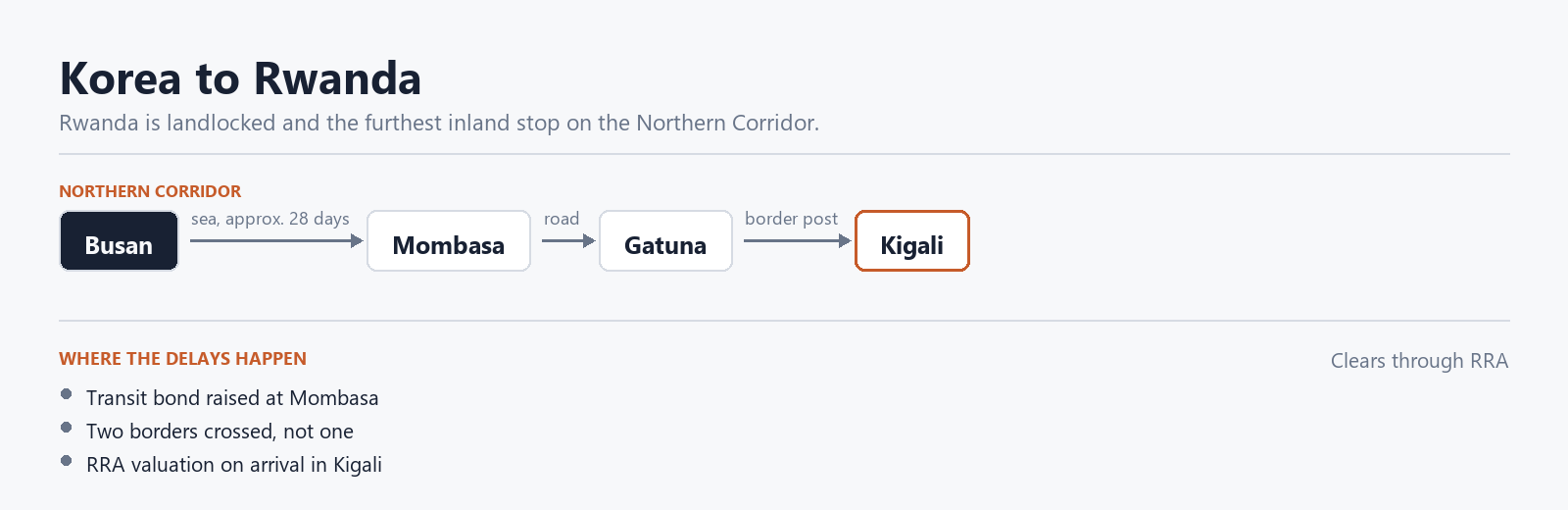
- indini Harbour) → Northern Corridor → Kigali Transit time from Busan: 35–42 days by RoRo vessel (K-Line, Wallenius Wilhelmsen, or MOL) Inland leg: 1,450 km Mombasa → Kigali via Nairobi–Nakuru–Busia–Kampala on the Northern Corridor (C8/A109).
- After customs clearance, vehicles must be registered through the Rwanda Development Board (RDB) using the Irembo digital platform.
What is Rwanda’s 8-year age rule?
Rwanda limits vehicle imports to those manufactured within the last 8 years from the year of importation. In 2026, that means model year 2018 or newer only.
The rule applies to the date of first registration in the origin country — not the manufacture stamp — which matters when sourcing through Korean auction houses, or JU Osaka (Korean vehicles relisted from Japan).
Why this matters for Korean used vehicles:
Korea’s domestic market produces high volumes of 2018–2024 models across Hyundai, Kia, and SsangYong lineups — precisely the generation Rwanda’s rule targets.
the Japanese export platforms primarily stock 2010–2016 Japanese domestic market vehicles, many of which fail Rwanda’s cutoff. Korean sourcing via SK AutoSphere or direct dealer platforms gives Rwandan buyers access to eligible inventory that Japanese exporters can’t competitively offer.
Model years currently eligible (as of 2026):
– 2018 Hyundai Tucson (TL facelift) — minimum eligible
– 2019 Kia Sportage (QL facelift) — strong value, widely available
– 2020–2023 Hyundai Santa Fe (TM generation) — premium segment
– 2021–2024 Kia Sorento (MQ4 generation) — Rwanda’s top-tier SUV segment
– 2018–2022 Hyundai H100 Porter / Kia Bongo 3 — commercial and fleet
How does RRA calculate duty?
Rwanda’s import duty framework for used vehicles runs through the Rwanda Revenue Authority under the East African Community (EAC) Common External Tariff (CET), with Rwanda-specific additions.
Key duties on CIF value:
| Charge | Rate |
|---|---|
| Import Duty (CET) | 25% |
| VAT | 18% |
| Infrastructure Levy | 1.5% |
| African Union Levy | 0.2% |
| EAC Development Levy (select models) | 2% |
Total effective rate for a mid-range SUV: approximately 45–48% on CIF.
CIF (Cost, Insurance, Freight) is calculated as: vehicle price in Korea + marine insurance + freight to Kigali via Mombasa or Dar es Salaam.
RRA uses its own reference valuation database — if your declared CIF appears below their benchmark for a given model and year, the higher RRA reference value applies.
Example — 2021 Kia Sportage sourced at $9,000–15,000 FOB Busan:
- FOB Korea: $9,000–15,000
- Freight (Busan → Mombasa, 40-day RoRo): ~$500–1,500
- Marine insurance: ~$120–180
- CIF Mombasa: ~$10,000–16,000
- Transit Mombasa → Kigali (inland): ~$1,000–2,500
- CIF Kigali declared: ~$12,000–19,000
- Import Duty (25%): $3,000–5,000
- VAT (18% on CIF + duty): $2,500–4,500
- Other levies (1.7%): $200–400
- Estimated total duty: ~$5,500–9,000
- All-in landed cost: ~$17,000–27,000
Should you route through Mombasa or Dar es Salaam?
Route 1: Busan → Mombasa (Kilindini Harbour) → Northern Corridor → Kigali
Transit time from Busan: 35–42 days by RoRo vessel (K-Line, Wallenius Wilhelmsen, or MOL)
Inland leg: 1,450 km Mombasa → Kigali via Nairobi–Nakuru–Busia–Kampala on the Northern Corridor (C8/A109). Truck transit 7–12 days depending on clearance at Malaba/Busia border.
Clearance point: ICDN (Inland Container Depot Nairobi) or direct Mombasa CFS clearance
Most Korean vehicles for Rwanda move through Mombasa. Established clearing agents in Mombasa familiar with RRA paperwork include EGL (East African Global Logistics) and Siginon Group, both with Kigali offices.
Route 2: Busan → Dar es Salaam (TPA) → Central Corridor → Kigali
Transit time from Busan: 38–48 days (slightly longer routing)
Inland leg: 1,250 km Dar → Kigali via Dodoma–Kahama–Rusumo border. Truck transit 8–14 days; Rusumo crossing typically faster than Malaba.
Best for: Containerized shipments; if your freight forwarder has TPA relationships; when Mombasa port is congested (common Q4).
Practical rule of thumb: For RoRo (most cost-effective for individual vehicles), Mombasa wins. For container loads (dealer bulk, spare parts consolidated), compare rates and congestion levels at time of booking.
How do you register an imported vehicle in Rwanda?
After customs clearance, vehicles must be registered through the Rwanda Development Board (RDB) using the Irembo digital platform. Required documents:
- Import Declaration Form (IDF) — issued by RRA at clearance
- Original title / Korean RC (자동차등록증) plus certified Korean-to-English translation
- RRA duty payment receipt
- REMA Compliance Certificate — Rwanda Environment Management Authority emission check; Korean vehicles from 2018+ generally pass Rwanda’s Euro 4 equivalent standard
Korean vehicles registered for Korean domestic market (KDM spec) are Left-Hand Drive (LHD) by default — Rwanda drives on the right, so LHD is the correct configuration.
This is a key advantage over Japanese domestic market (JDM) vehicles, which are Right-Hand Drive and require conversion (adding cost and reducing resale value).
REMA pass rate for Korean 2018–2024 models: High. Hyundai Kappa/Gamma engines, Kia Nu/Theta II with factory catalytic converters, and the post-2018 Smartstream series all meet Rwanda’s emission threshold without modification.
Older diesel-only models (pre-Euro 4) are higher risk — request the Korean vehicle inspection certificate (자동차검사증) to confirm emission system status before shipping.
Which Korean models perform best in Rwanda?
Rwanda’s geography (1,000–2,500 m elevation, unpaved rural roads outside Kigali) and fuel availability (petrol more accessible than diesel in rural areas) shape demand:
Top performers by segment:
| Segment | Model | Why it works |
|---|---|---|
| Urban SUV | 2019–2022 Kia Sportage | Reliable, low maintenance, 2.0L petrol available at all fuel grades |
| Family SUV | 2020–2023 Hyundai Tucson | High altitude performance, proven resale in Kigali |
| Premium SUV | 2021–2024 Kia Sorento (MQ4) | Corporate buyer segment, visible prestige in Kigali CBD |
| Minibus / fleet | 2019–2023 Hyundai H350 (Solati) | Growing demand from Kigali bus cooperative operators |
| Pick-up | 2018–2023 Hyundai Santa Cruz (N/A for import) / Kia Sportage AWD | Note: dedicated pick-up demand lower than Kenya/Tanzania |
Models to avoid for Rwanda: Pre-2018 SsangYong Rexton and Musso (age rule risk), high-displacement V6+ engines (fuel cost sensitivity in landlocked market), and any diesel with DPF requiring premium diesel not widely available outside Kigali.
Sourcing Checklist for Rwanda-Bound Korean Vehicles
- ☐ Confirm model year ≥ 2018 (check first registration date on Korean RC, not manufacture plate)
- ☐ Pull full Korean vehicle history report (자동차 이력정보) via carhistory.or.kr — RRA occasionally requests this for high-value units
- ☐ Confirm LHD configuration (all KDM spec vehicles are LHD — verify for any re-exported units)
- ☐ Get pre-shipment inspection from a Korea-based inspector before RoRo loading at Pyeongtaek or Busan New Port
- ☐ Confirm REMA-eligible engine spec (Euro 4+ or Smartstream series)
- ☐ Book freight with RoRo carriers serving Mombasa (K-Line, MOL) or Dar (MSC, CMA CGM container for bulk)
- ☐ Engage a clearing agent with active RRA agency registration (required for customs filing in Rwanda)
- ☐ Budget 6–8 weeks total from Korea purchase to Kigali registration
Are EVs and hybrids worth importing into Rwanda?
Rwanda’s Vision 2050 and the National Electric Mobility Policy (2021) commit to progressively incentivizing EVs. As of 2026, import duty concessions for BEVs and plug-in hybrids (50% duty reduction under EAC’s revised schedule) are not yet fully harmonized, but Kigali-based fleet operators are actively watching.
Korean EV exports — particularly 2022–2024 Kia EV6 and Hyundai IONIQ 5 — are technically eligible and LHD-compatible, though charging infrastructure outside Kigali remains limited to a handful of Rwanda Energy Group (REG) fast-chargers. Monitor this space for 2027 sourcing decisions.
Verified sourcing data: the Korean domestic listing market dealer listings (accessed June 2026); RRA customs duty schedule (Rwanda Revenue Authority, 2024); EAC Common External Tariff schedule (2022 revision); REMA vehicle import standards; TPA and Kenya Ports Authority transit guides.
Sourcing Korean stock for your next container? Tell us the destination port, the model year you are targeting and the spec, and we come back with matched units and a landed figure per unit. Start at SK AutoSphere, or browse the parts catalogue.
How we source this vehicle
Korean supply for this model is deep. The variable that separates a good unit from a cheap one is the auction grade sheet, not the listing photos.
That sheet is written in Korean shorthand that does not translate cleanly, and it is where margin is won or quietly lost. Reading it, and the physical inspection behind it, is the part we do.
We reject the units that photograph well and inspect badly, before anyone pays for one. Four things let us come back with a matched shortlist and a landed figure per unit:
- Destination port — this sets the age cutoff and the duty band.
- Body and seat count — this changes the trim list, not just the price.
- Target model year — anchored to your port’s over-age cliff.
- Fuel — diesel unless your buyer has a specific reason to want petrol.