Importing Korean Used Vehicles Into Zambia: ZRA Duties, the Nakonde-Kazungula Choice, and the LHD Problem Nobody Mentions
Zambia is landlocked, drives on the left, and taxes vehicles by engine size — three facts that quietly decide whether a Korea-sourced import turns a profit or sits in a Lusaka compound for six months waiting on a re-registration dispute.
Most import guides written for West Africa don’t transfer cleanly here. This one is Zambia-specific.
The short version
- Zambia has no coastline, so every Korean vehicle arrives via a neighboring country’s port and crosses a land border.
- This is the detail that catches first-time Zambian importers off guard.
- The Zambia Revenue Authority calculates import duty on used motor vehicles using a Customs Value based on VIN/engine data, not a flat percentage of declared invoice price.
- The Zambia Bureau of Standards (ZABS) requires a roadworthiness and standards compliance check before RTSA will issue plates — separate from, and in addition to, any pre-shipment inspection done in Korea.
Should you route Zambian imports through Dar es Salaam or Durban?
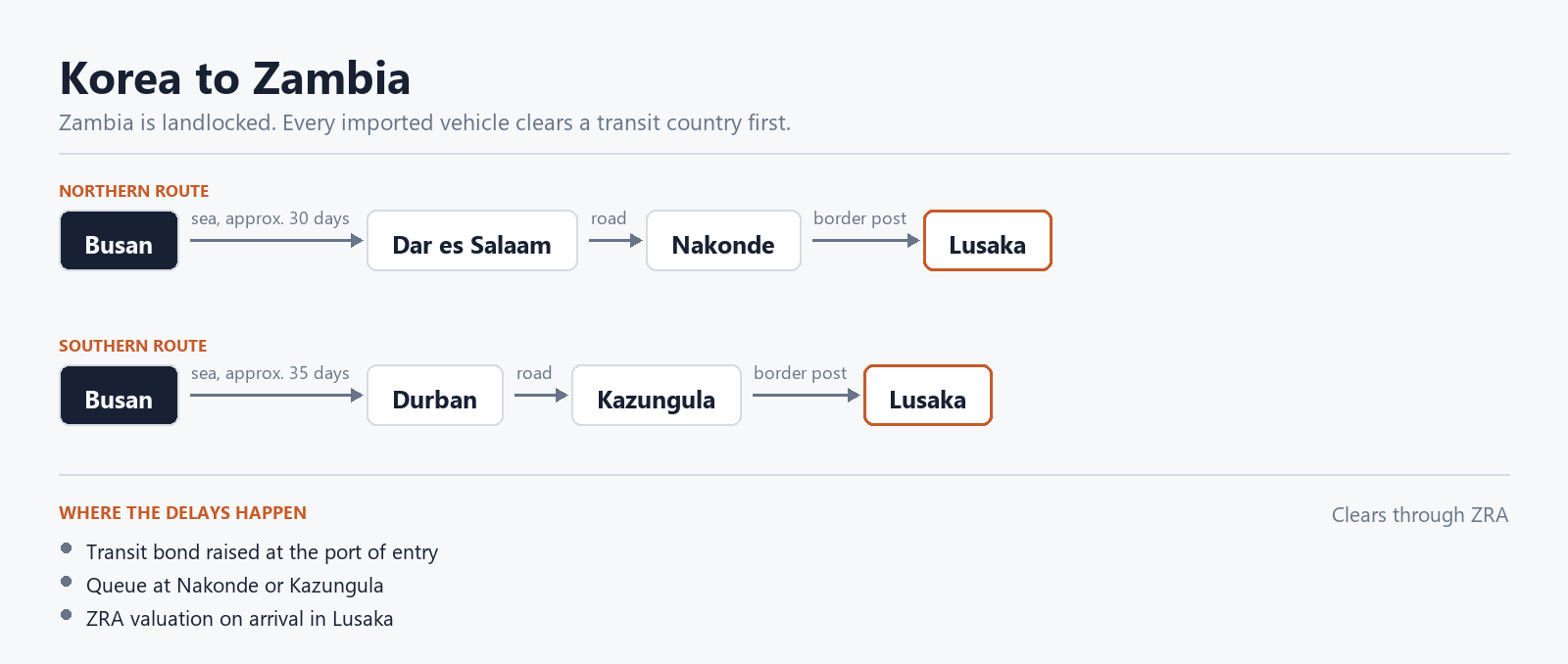
Zambia has no coastline, so every Korean vehicle arrives via a neighboring country’s port and crosses a land border. Two corridors dominate:
Dar es Salaam (Tanzania) → Nakonde border → Great North Road → Lusaka. This is the shorter route on paper — roughly 1,900 km from port to Lusaka — but Nakonde is a notoriously congested single-lane border post, and truckers routinely report 3-7 day queues during TAZARA rail congestion or fuel-tanker backups.
Ro-ro or container discharge at Dar es Salaam Port typically runs 10-18 days before the vehicle even clears Tanzanian customs for transit.
Durban (South Africa) → Beitbridge or Kazungula Bridge → Lusaka. Longer in kilometers (over 2,600 km) but the road infrastructure is better maintained and the Kazungula Bridge — opened in 2021, replacing the old pontoon ferry between Botswana and Zambia — has meaningfully cut crossing time versus the Chirundu route through Zimbabwe.
Freight forwarders quoting this corridor in 2026 are pricing 25-32 days port-to-Lusaka door, versus wider variance (18-35 days) on the Dar es Salaam route depending on Nakonde conditions that week.
Neither corridor is reliably faster; the honest operator answer is to ask your freight forwarder which route they cleared vehicles through in the last 30 days, not which route looks shorter on a map.
Can left-hand-drive Korean stock be registered in Zambia?
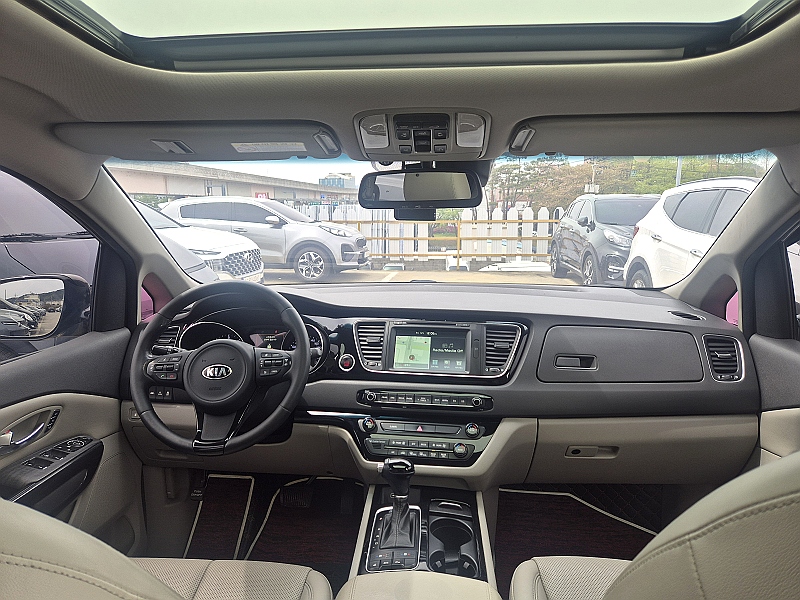
This is the detail that catches first-time Zambian importers off guard. Zambia is a left-hand-traffic country — vehicles must be right-hand drive (RHD).
South Korea is a right-hand-traffic country, and the vast majority of vehicles registered and sold on the Korean domestic listing market or through Korean domestic auctions are left-hand drive (LHD), built for the Korean domestic market.
Genuine RHD Korean-brand stock exists, but it comes from a narrower pool: export-spec Hyundai and Kia units built for RHD markets (UK, Japan-adjacent export orders, or Southeast Asian assembly) that get re-exported second-hand, or units KOTSA-registered under diplomatic/export plates that never entered Korean domestic circulation.
Buyers who don’t specify RHD explicitly — and don’t insist on seeing the steering position in photos before wiring a deposit — end up with an LHD vehicle that Zambia’s Road Transport and Safety Agency (RTSA) will not register for private road use.
This single misunderstanding accounts for more stranded-deposit disputes than any customs issue.
How does ZRA calculate duty on an imported vehicle?
The Zambia Revenue Authority calculates import duty on used motor vehicles using a Customs Value based on VIN/engine data, not a flat percentage of declared invoice price. The published structure combines:
- Customs Duty — 25% of the ZRA-assessed customs value for most passenger vehicles.
- Excise Duty — banded by engine capacity: roughly 20% for vehicles under 1,500cc, climbing to 30% for vehicles over 3,000cc. This is the single biggest lever importers get wrong when sourcing a 2.5L+ Korean SUV assuming duty tracks like a 1.6L sedan.
- VAT — 16%, applied cascading on top of (customs value + customs duty + excise duty), not on the base value alone.
- Surtax — a 5% penalty applied to vehicles older than 5 years from year of manufacture, stacked on top of the above.
Run the math on a 2019 Hyundai Tucson (2.0L) versus a 2021 Kia Sportage (1.6L turbo) sourced at similar KRW auction prices, and the Sportage clears meaningfully cheaper — not because it’s a better vehicle, but because the excise band alone can add several hundred dollars to the landed cost of the larger engine.
Source Korean auction sheets (the Korean domestic listing market, SK AutoSphere listings) with the ZRA excise band in mind before bidding, not after the vehicle lands at Nakonde.
What inspection does ZABS require before RTSA registration?
The Zambia Bureau of Standards (ZABS) requires a roadworthiness and standards compliance check before RTSA will issue plates — separate from, and in addition to, any pre-shipment inspection done in Korea.
A clean Korean inspection report (KOTSA-style condition grading, or the equivalent SK AutoSphere AI condition report) reduces the risk of ZABS flagging structural or emissions issues on arrival, but it doesn’t substitute for the local check.
Budget for both: the Korea-side inspection catches problems before you pay for freight; the ZABS check is a mandatory local gate you cannot skip regardless of how clean the Korean paperwork looks.
What actually goes wrong on this route?
Three failure patterns show up repeatedly in Zambian import forums and forwarder complaints:
- LHD vehicles bought sight-unseen on price alone, discovered only at RTSA registration — by which point the vehicle has already cleared customs and duty is non-refundable.
- Underestimating excise duty on larger-engine SUVs, blowing the landed-cost budget on vehicles that looked cheap on the Korean auction sheet.
- Choosing Nakonde during TAZARA rail congestion periods without checking current border conditions, adding 2-3 weeks of demurrage the buyer didn’t price in.
None of these are exotic risks. They’re the same three mistakes repeating across corridors, because most sourcing guidance written for this trade is generic and doesn’t account for Zambia’s specific combination of landlocked geography, RHD requirement, and engine-banded excise duty.
This guide covers general ZRA duty structure and corridor conditions as of 2026 and is not a substitute for a current ZRA customs valuation or a licensed clearing agent’s assessment — duty bands and border conditions change without notice.
Sourcing Korean stock for your next container? Tell us the destination port, the model year you are targeting and the spec, and we come back with matched units and a landed figure per unit. Start at SK AutoSphere, or browse the parts catalogue.