Importing Korean Used Vehicles into Ethiopia: ERCA Rules, Djibouti Routing, and What Actually Lands
Ethiopia’s used vehicle market is one of East Africa’s most active — and one of its most demanding to navigate.
Addis Ababa’s explosive taxi and transport fleet expansion has kept demand for Korean diesel MPVs and SUVs consistently high, but the customs regime under the Ethiopian Revenue and Customs Authority (ERCA) punishes the unprepared.
This guide walks through the full sourcing-to-clearance flow for Korean vehicles bound for Ethiopia via Djibouti.
The short version
- nal, then transit by road or rail on the Ethiopia-Djibouti Standard Gauge Railway (SGR) to either Modjo Dry Port (formerly “Mojo ICD”), roughly 75 km south-east of Addis Ababa, or the older Dire Dawa ICD on the eastern corridor.
- Ethiopian vehicle import taxes stack in a way that surprises first-time importers.
- Two rules filter out most of the Korean market immediately: 1.
- LHD via European returns (rarer) The H1 Starex dominates because the 2.5 CRDi engine is the same unit used across the Hiace-equivalent market — mechanics in Addis Ababa know the A2 timing belt service schedule and the injector failure modes.
Why route Ethiopian imports through Djibouti?
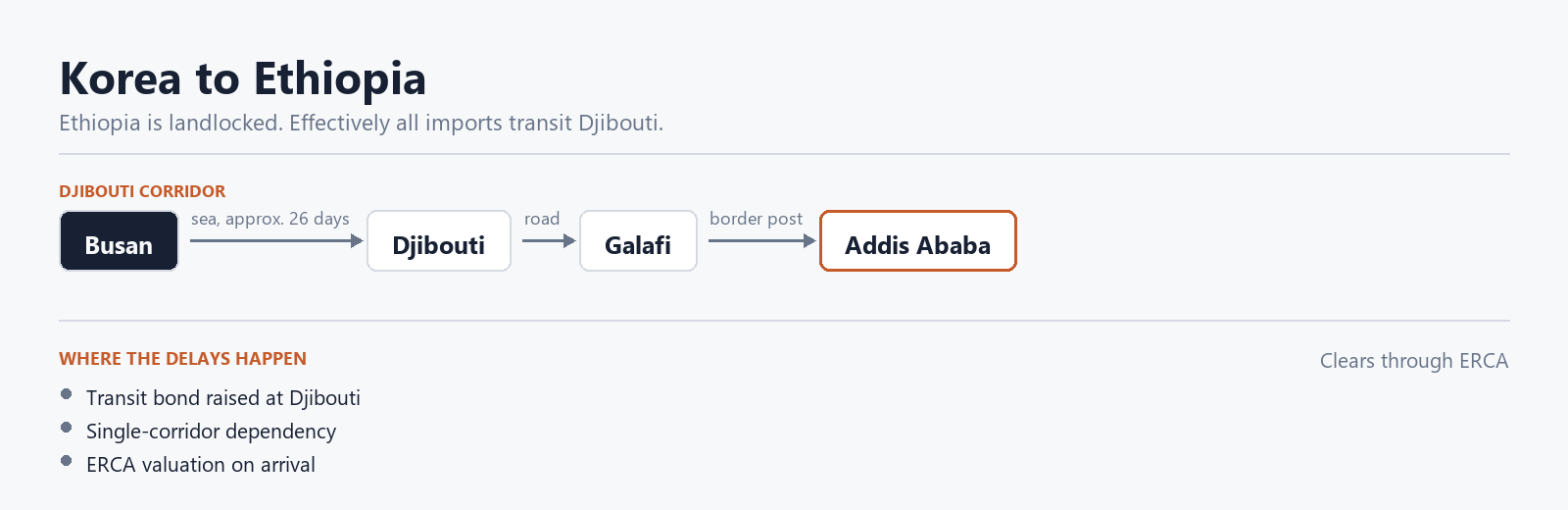
Ethiopia is landlocked.
Unlike Kenya-routed cargo (which clears SVR at Mombasa and moves by rail to Nairobi ICD), Ethiopian imports arrive by sea at Djibouti’s Doraleh Multi-Purpose Port or the adjacent DP World Doraleh Container Terminal, then transit by road or rail on the Ethiopia-Djibouti Standard Gauge Railway (SGR) to either Modjo Dry Port (formerly “Mojo ICD”), roughly 75 km south-east of Addis Ababa, or the older Dire Dawa ICD on the eastern corridor.
Most consignees clearing vehicles prefer Modjo because customs officers are familiar with bulk RoRo documentation and the yard is larger. Dire Dawa is faster for break-bulk but queues for ERCA inspection can stretch longer during agricultural import season (Oct–Jan).
Transit time from Busan to Djibouti Doraleh on standard Korea–Horn of Africa services via K-Line’s AHX eastbound leg or Simatech / MOL (MITSUI OSK) Horn of Africa feeder is 22–27 days.
Add 3–7 days Djibouti dwell and 1–2 days Modjo transit = 27–36 days port-to-ICD, which is 5–8 days faster than the Mombasa-to-Modjo truck road alternative.
How does ERCA calculate duty?
Ethiopian vehicle import taxes stack in a way that surprises first-time importers. ERCA applies the following charges on CIF Djibouti value (not FOB):
| Charge | Rate |
|---|---|
| Customs duty | 35% of CIF |
| Excise tax | 30–60% of (CIF + duty), engine-displacement-tiered |
| VAT | 15% of (CIF + duty + excise) |
| Sur-tax / withholding | 3% of CIF |
| ERCA processing levy | ~0.5–1% (admin) |
Effective rate example — 2020 Hyundai Tucson 2.0L (CIF $9,000–15,000):
| Step | Calculation | Amount |
|---|---|---|
| CIF | — | $9,000–15,000 |
| Customs duty (35%) | $9,000–15,000 × 0.35 | $3,000–5,500 |
| Excise tax (30%, 2.0L) | ($9,000–15,000 + $3,000–5,500) × 0.30 | $3,500–6,000 |
| VAT (15%) | ($9,000–15,000 + $3,000–5,500 + $3,500–6,000) × 0.15 | $2,500–4,000 |
| Sur-tax (3%) | $9,000–15,000 × 0.03 | $200–500 |
| Landed total | $54,200–91,000 |
The effective burden is approximately 105% of CIF, making Ethiopia one of the highest-tariff vehicle markets in the continent. Engine displacement is the excise-tier driver: 1.6L and below attracts 30% excise; 1.8–2.5L attracts 30–40%; above 3.0L climbs to 60%.
This is why the Hyundai H1 Grand Starex (2.5L diesel turbo) is so dominant in Ethiopian fleets despite the additional excise — it’s the optimal balance of payload, durability, and the relatively predictable 40% excise bracket.
What are Ethiopia’s drive-side and age rules?
Two rules filter out most of the Korean market immediately:
1. Left-hand drive (LHD) mandatory. Ethiopia drives on the right. ERCA will not clear right-hand-drive vehicles under any import declaration — there is no waiver process. This immediately rules out the entire Japanese domestic market (JDM) inventory that flows through the Japanese export platforms.
Korean vehicles produced for export markets are LHD from the factory, which is a core advantage: Hyundai, Kia, and SsangYong all export LHD units to Europe, the Middle East, and North Africa, and those same vehicles enter Korean auction channels when returned after lease terms end (typically 3–5 year used lease returns from Saudi Arabia, UAE, or Algeria).
These are exactly the units you want to source.
2. Maximum age: 8 years at the date of customs declaration. A vehicle manufactured in 2016 cannot clear ERCA in 2025 (it would be 9 years old at import).
The rule is by manufacture date, not registration date — if ERCA’s system shows the manufacturing year as 2016 on the Korean Export Certificate (한국자동차수출인증서), that’s the date used, regardless of when it was first sold.
This catches importers who buy “low-mileage ex-diplomatic vehicles” without verifying manufacture date on the certificate.
Which models sell best in Ethiopia?
Based on demand signals from Addis Ababa brokers and Modjo Dry Port clearing records (source: importer community reports, 2023–2025):
| Model | Engine | Why Dominant |
|---|---|---|
| Hyundai H1 Grand Starex (2016–2019) | 2.5 CRDi diesel | 12-seat fleet, gearbox reliability, Addis-to-regional routes |
| Kia Carnival (2018–2020) | 2.2 CRDi diesel | Family + hotel shuttle, urban |
| Hyundai Santa Fe (2018–2021) | 2.0 T-GDi / 2.2D | SUV demand, government/NGO fleet |
| Kia Sorento (2019–2021) | 2.2D LHD ex-GCC | Similar to Santa Fe; sometimes cheaper from UAE returns |
| SsangYong Musso (2019+) | 2.2D | Pick-up market, LHD via European returns (rarer) |
The H1 Starex dominates because the 2.5 CRDi engine is the same unit used across the Hiace-equivalent market — mechanics in Addis Ababa know the A2 timing belt service schedule and the injector failure modes. A vehicle no local mechanic can service is a liability regardless of condition score.
RoRo or container from Busan?
For Ethiopia, RoRo is strongly preferred over container shipping for a specific reason: Doraleh Multi-Purpose Port handles RoRo vessels routinely (UECC/EuroCarrier occasional rotations; more commonly chartered break-bulk car carrier slots booked through Busan-based freight forwarders).
Container shipping requires unstuffing at Djibouti port, which adds a port unstuffing fee of $150–$300 USD per unit that is rare in RoRo flows.
Djibouti port charges are calculated in USD and are among the highest in the region — PAID-days demurrage after 7 free days runs at $35–$60/unit/day for RoRo and $55–$85/TEU/day for containers. Get your ERCA paperwork pre-cleared by your Djibouti agent before the vessel arrives.
Key Busan-Djibouti forwarders with Korea-Horn of Africa experience (2025 active): DHL Global Forwarding Korea (Busan office), Pantos Logistics (Hyundai/Kia affiliate, heavy on Horn routes), and independents like Koryong Shipping who specialize in vehicle export consolidation.
Avoid general freight brokers who do not have active Djibouti port relationships — customs tariff codes for vehicles (HS 8703 for passenger, 8704 for commercial) require specific B/L endorsements that inexperienced forwarders miss.
What are the three traps on this route?
Trap 1 — The CIF valuation dispute. ERCA maintains a reference price list (tariff value schedule) for common Korean models. If your declared CIF is lower than ERCA’s reference, they raise the taxable value to the schedule figure.
The Hyundai Tucson 2020 LHD 2.0L has an ERCA reference value that sits approximately 15–20% above Korean market wholesale prices in 2024–2025. Factor this in when building landed cost: declare the honest invoice value but expect ERCA to assess the reference if you bought cheaply.
Trap 2 — The “export certificate” scramble. ERCA requires a Korean Export Certificate (자동차 수출 통관 서류) authenticated by the Korean Customs Service.
If you bought from an the Korean domestic listing market-listed private seller rather than a licensed export dealer, obtaining this document requires the seller to file a formal export declaration in Korea — which they may refuse or be unable to do after the sale.
Source from registered export dealers who include this document as standard. Request it before payment; do not accept “we’ll send it later.”
Trap 3 — The SGR surcharge. Since 2020, the Ethiopian-Djibouti SGR has shifted from government-subsidized to commercially priced rail service. Vehicle rail transport Djibouti to Modjo has risen from ~$200–300/unit to ~$450–$550/unit (2024 rates).
Some importers revert to truck to save $150–200, but the Dire Dawa–Addis road is subject to security escort requirements at certain periods — road haulage can add unpredictable delays and security costs. Budget for SGR unless your clearing agent has a reliable truck arrangement with a Dire Dawa ICD-licensed hauler.
What pre-shipment checks does Ethiopia require?
ERCA does not currently require a pre-shipment inspection certificate (unlike Ghana’s CEPS/GICCS process). However, NGO buyers and large fleet purchasers increasingly require carhistory.or.kr reports and third-party mechanical inspection (arranged via Incheon-based agents like AutoRoad Korea or individual mechanics hired through Expat Korea forums).
For retail-level buying, SK AutoSphere’s AI condition report (with a CARHISTORY cross-check option) fills this gap — it gives you a documented condition basis that your Djibouti clearing agent can attach to the commercial invoice if ERCA queries the declared value.
Summary: Ethiopian Import in Five Numbers
| Figure | Value |
|---|---|
| Effective total tax burden on CIF | ~100–110% |
| Maximum vehicle age at ERCA clearance | 8 years from manufacture |
| Drive side | Left-hand drive only |
| Busan → Modjo transit (RoRo + SGR) | 27–36 days |
| Djibouti demurrage free days | 7 days (RoRo), then $35–$60/day |
Ethiopia rewards importers who do the math upfront.
The duty stack is punishing, but LHD Korean fleet vehicles — especially the H1 Starex and GCC-return Santa Fe — remain competitive against European alternatives at CIF prices below $12,000–18,000 because spare parts are locally available and residual values hold in the Addis Ababa taxi and NGO market.
Sourcing Korean stock for your next container? Tell us the destination port, the model year you are targeting and the spec, and we come back with matched units and a landed figure per unit. Start at SK AutoSphere, or browse the parts catalogue.
How we source this vehicle
Korean supply for this model is deep. The variable that separates a good unit from a cheap one is the auction grade sheet, not the listing photos.
That sheet is written in Korean shorthand that does not translate cleanly, and it is where margin is won or quietly lost. Reading it, and the physical inspection behind it, is the part we do.
We reject the units that photograph well and inspect badly, before anyone pays for one. Four things let us come back with a matched shortlist and a landed figure per unit:
- Destination port — this sets the age cutoff and the duty band.
- Body and seat count — this changes the trim list, not just the price.
- Target model year — anchored to your port’s over-age cliff.
- Fuel — diesel unless your buyer has a specific reason to want petrol.