Hyundai Grand Starex (H-1) for West African Transport Fleets: What Korean Auctions Know That HiAce Buyers Are Missing
The 12-seat Hyundai Grand Starex — sold as the H-1 in most export markets — is the most under-sourced vehicle in the West African corporate transport segment. Fleet managers in Accra, Abidjan, and Lagos pay a 25–35% premium for equivalent-year Toyota HiAce units based almost entirely on brand familiarity.
Meanwhile, 2017–2021 Grand Starex TQ-generation vans in A-grade condition are clearing the manufacturer-run auction lanes; Tuesday van lots in Incheon at ₩14,500,000–₩18,200,000 (approximately $10,600–$13,300 at July 2026 rates) for the 2.5-litre CRDi diesel with under 80,000 km.
This guide is for fleet operators who can close that price gap — if they know what they’re looking at.
The short version
- The H-1’s case for West African fleet use rests on three structural advantages that rarely appear in the export-platform listings.
- Korean auctions grade vehicles on an R-S-A-B-C-D scale, with a separate damage notation map covering 33 body panels.
- Three sourcing channels account for most of the export-quality inventory.
Why the Grand Starex Deserves Serious Consideration
The H-1’s case for West African fleet use rests on three structural advantages that rarely appear in the export-platform listings.
The 12-seat configuration is a legal differentiator. In Ghana, the DVLA classifies any van seating 10 or more passengers as a “stage carriage” eligible for fleet operator licensing under the Road Traffic Act 2004 (Act 683). The 12-seat Grand Starex meets this threshold; the 9-seat variant does not.
Fleet operators running corporate shuttle contracts in the Accra-Tema corridor — including logistics firms on Tema’s Industrial Area 1 who run supplier shuttle routes — report that DVLA fleet licensing provides a meaningful insurance cost reduction under NIC Ghana’s motor fleet product: roughly 18–22% lower annual premium per seat compared with insuring each unit individually as a private hire vehicle.
The CRDi engine ecosystem has Korean government backing. Hyundai’s 2.5-litre D4CB engine (fitted to TQ-generation Grand Starex from 2007 through production end in 2021) is also the powertrain in Hyundai’s HD65/HD72 light commercial trucks, which Korea’s Ministry of Land, Infrastructure and Transport approved for public utility vehicle use.
This means D4CB engine components — injectors, high-pressure fuel pump (Bosch CP1H common rail), EGR cooler, timing chain kit — are stocked by Hyundai’s own official parts exporters at volume pricing.
The Bupyeong auto parts district in Incheon (부평 자동차 부품 상가), a 12-block cluster of 340+ parts dealers near Bupyeong Station on Line 1, stocks D4CB rebuild components at prices 30–45% below what the same parts cost through UAE grey-market distributors that serve West Africa’s Accra and Lagos spare parts corridors.
Fleet maintenance intervals are genuinely longer than the HiAce equivalent. Hyundai specifies a 15,000 km engine oil service interval for the D4CB under normal operating conditions, versus Toyota’s 10,000 km for the 2KD-FTV engine in the HiAce.
For a fleet running 4,000 km/month — typical for Accra-Cape Coast corporate shuttle routes — that’s roughly 5 fewer oil changes per year per unit.
At Ghanaian market rates for semi-synthetic diesel engine oil (approximately GHS 180–220 per oil change for a workshop in East Legon), that’s GHS 900–1,100 in direct operating cost savings annually, per van. Fleet operators running 8–12 units compound that figure.
Reading a Grand Starex Auction Grade Sheet
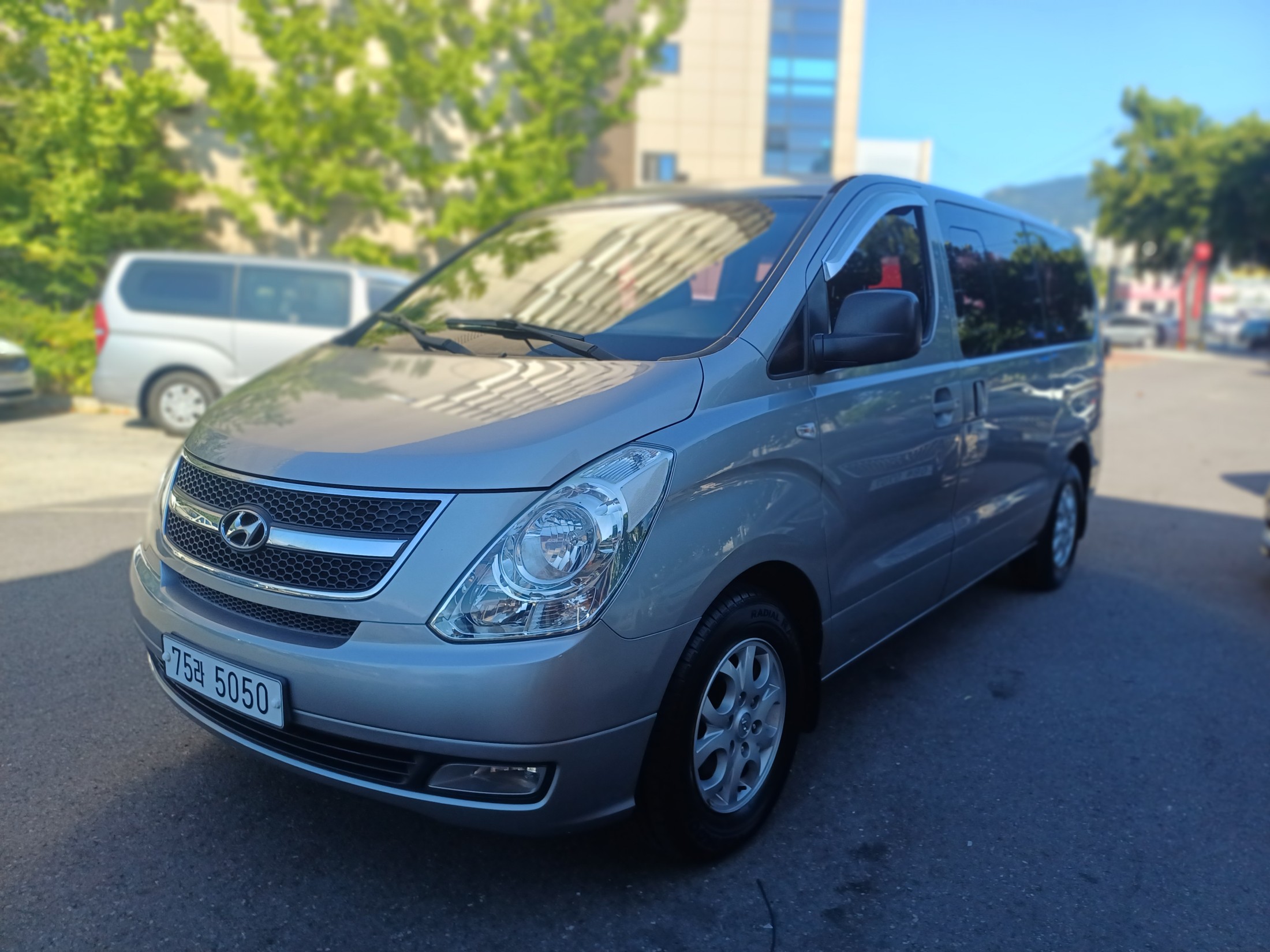
Korean auctions grade vehicles on an R-S-A-B-C-D scale, with a separate damage notation map covering 33 body panels. For the Grand Starex specifically, three damage codes represent fleet-critical risks that the grade letter alone won’t reveal.
Code 6 (교환, Replaced) on the B-pillar or C-pillar. The Grand Starex’s sliding side door is supported by the C-pillar, and a B-pillar replacement in a van this size almost always indicates a significant side-impact. manufacturer-run auction rules require disclosure and map notation, but do not prohibit sale.
Reject any unit with a Code 6 on either pillar for passenger fleet use — the structural integrity of a replaced pillar in a used Korean van is not independently certified.
Code U (요수리, Needs Repair) on the sliding door rails or the roof panel. The TQ Grand Starex’s powered sliding door is a high-cycle component: corporate shuttle use in West Africa typically logs 80–120 door cycles per day per vehicle.
A “U” notation on the door rail means the mechanism was already degraded before export.
Budget ₩350,000–₩500,000 for rail replacement in Korea (ask your Korean sourcing agent — SB Tech Korea in Incheon and HanAuto Export in Busan both handle pre-shipment repairs for export clients) before the unit ships, or negotiate that amount off the bid price.
Code W (부식, Rust/Corrosion) in the undercarriage section. Units registered in Gangwon-do, North Gyeonggi, or North Chungcheong provinces — Korea’s snowbelt — carry higher road salt exposure. Pull the vehicle registration history (차량등록원부) through Korea’s Ministry of the Interior e-Gov portal (www.gov.kr) before bidding.
The document costs ₩300–500 and takes 5 minutes online; your Korean agent should be doing this as standard practice. Reject any unit with W-code undercarriage corrosion for humid coastal climates like Lagos Island or Tema — salt-compromised chassis welds fail faster under high humidity.
Where Grand Starex Units Actually Trade in Korea
Three sourcing channels account for most of the export-quality inventory.
the manufacturer-run auction lanes, Incheon. Hyundai’s own auction subsidiary runs the largest dedicated commercial vehicle lots in Korea.
Tuesday sessions at the Incheon Logistics Center (near Terminal 1 of Incheon International Airport, accessible from Yeongjong Island) regularly carry 15–30 Grand Starex units, ranging from recent lease returns (2020–2021, under 50,000 km) at ₩19,000,000–₩24,000,000 to 2016–2018 high-mileage units at ₩10,000,000–₩14,000,000.
Lease-return units from Korean corporate fleets carry mandatory maintenance logs under the Corporate Tax Act, which is verifiable before bidding.
the large domestic dealer chains Platform — Used Van Category. the large domestic dealer chains, Korea’s largest used car marketplace with 65,000+ listings, has a dedicated van category (승합차) that lists Grand Starex units with full accident history, odometer certification by the Korea Automobile Management Association (KAMA), and dealer-verified service records. the large domestic dealer chains prices run 5–10% above manufacturer-run auction floor for comparable units because the platform takes retail-grade delivery preparation.
For fleet buyers who want less sourcing friction and can absorb the premium, the large domestic dealer chains is the most reliable single source for verified-history units.
the export-facing aggregators Direct Dealer Listings. the export-facing aggregators’s platform aggregates inventory from Korean Hyundai commercial vehicle dealers and independent van specialists.
In June 2026, the export-facing aggregators showed 47 Grand Starex TQ units ranging ₩12,500,000–₩22,000,000 CIF Busan for export. the export-facing aggregators dealers typically include port delivery to Busan New Port (BPN) or Pyeongtaek Port in the quoted price, which simplifies the landed cost calculation.
Be aware that the export-facing aggregators dealer prices are negotiable — 8–12% below list is achievable on fleet volume orders of 3+ units.
Calculating Landed Cost: Korea to Tema (Ghana)
A 2020 Grand Starex CRDi, A-grade, 65,000 km, priced at ₩13,000,000–21,000,000 (≈$9,000–15,000) at GLOVIS or the export-facing aggregators.
Korea-side costs:
– Vehicle price: ₩13,000,000–21,000,000 (~$9,000–15,000)
– Pre-shipment inspection (Korea Automobile Testing & Research Institute / KATRI, or independent): ₩150,000–₩250,000 (~$110–$180)
– Documentation (export certificate, deregistration, insurance): ₩160,000–240,000 (~$110–180)
– Freight to Tema (RoRo, Busan–Tema via Grimaldi or EUKOR, 28–35 days): ~$850–$1,100/unit
Ghana-side costs:
– CIF value for customs: ~$10,000–17,000 (vehicle + freight + insurance)
– Ghana Customs Import Duty (vehicle >5 years): 20% CIF = ~$2,000–3,500
– NHIL (2.5%): ~$200–500
– GETFund Levy (2.5%): ~$200–500
– Ghana Revenue Authority customs processing: ~$150–$200
– DVLA registration + road-worthy certificate: ~GHS 600–800 (~$45–$60)
– Port handling at Tema: ~$180–$250
Total landed (approximate): $18,200–$19,600 per unit.
A comparable 2020 Toyota HiAce GL in A-grade condition from the same auction cycle lands at $23,500–$26,000 in Tema via the same RoRo route. The $4,000–$7,000 per-unit gap on a 10-van fleet purchase is $40,000–$70,000 — enough to fund 2–3 years of differential maintenance costs even in a worst-case scenario.
The Failure Mode Korean Dealers Don’t Volunteer
The D4CB engine’s documented weakness in West African operating conditions is injector fouling from low-cetane diesel.
Ghana’s petroleum fuel standard (GS 190:2008) mandates a minimum 48 cetane rating; actual quality at rural filling stations on the Accra–Kumasi corridor regularly measures 42–45 cetane by lab test (reported by GOIL’s quality assurance team in a 2024 internal audit disclosed to the Ghana National Petroleum Corporation board).
Low-cetane diesel accelerates injector tip deposits and shortens the interval between injector cleaning cycles from the Hyundai-spec 60,000 km to 25,000–35,000 km in practice.
The fix is cheap and preventable: fit an inline diesel fuel additive system (Stanadyne Performance Formula is the most available in Accra, stocked by Accra-based spare parts dealer Auto City on Spintex Road) and run fuel filter replacement at 10,000 km instead of the standard 20,000 km.
Total additional cost per unit: approximately $90–150/year at Accra parts pricing.
This information is available on Hyundai’s Korea-language technical service bulletins (TSB), which your Korean sourcing agent should be able to retrieve from Hyundai’s dealer technical portal. If your agent can’t pull TSBs, find a different agent.
What to Ask Before You Bid
Three questions that will separate a reliable Grand Starex sourcing agent from one working from a listing screenshot:
-
Can you pull the 차량등록원부 (vehicle registration certificate history) and the 성능기록부 (performance inspection record) before I commit to the bid? Both documents are legally required to be available on the auction floor in Korea.
If your agent can’t produce them within 24 hours of identifying a target unit, they don’t have floor access.
-
What is the D4CB injector status on the inspection sheet? A legitimate A-grade unit should have a clean injector note. If the inspection sheet shows “요점검 (requires inspection)” against the fuel system, budget ₩800,000–₩1,200,000 for injector service before the unit ships.
-
Has the timing chain been serviced? The D4CB’s timing chain stretch is a known failure point above 120,000 km. Ask for the service record. If the vehicle is above 100,000 km and there’s no timing chain service record, factor ₩600,000–₩900,000 into your offer price.
The Fleet Buyer’s Summary
| Factor | Grand Starex TQ (2017–2021) | Toyota HiAce GL (equiv. year) |
|---|---|---|
| Landed cost, Tema | $18,200–$19,600 | $23,500–$26,000 |
| 12-seat config (DVLA fleet threshold) | Yes (standard) | Rare (usually 9-seat) |
| Engine oil service interval | 15,000 km (D4CB spec) | 10,000 km (2KD-FTV spec) |
| OEM parts export from Korea | Available via Bupyeong corridor | Via Toyota TSAM (South Africa) |
| Cetane-sensitivity risk | High (mitigable with additive + shorter filter interval) | Moderate |
| Auction availability (GLOVIS Tuesday) | High — 15–30 units/session | Moderate — 5–10 units/session |
The Grand Starex is not the right choice for a fleet operator who lacks a reliable Korean sourcing agent, because the pre-bid documentation review is what makes the difference between a sound unit and a problem import.
But for operators who can access GLOVIS directly — or who work with an agent who can — the H-1 represents a real, quantifiable cost advantage that the market hasn’t priced in yet.
SK AutoSphere sources and verifies Grand Starex fleet units for West African buyers, with AI-assisted condition assessment and pre-shipment inspection coordination through our Incheon-based partners. All vehicle pricing data reflects manufacturer-run auction records and the export-facing aggregators platform listings as of June–July 2026 and is subject to market movement.
Sourcing Korean stock for your next container? Tell us the destination port, the model year you are targeting and the spec, and we come back with matched units and a landed figure per unit. Start at SK AutoSphere, or browse the parts catalogue.