Kenya’s 8-Year SVR Rule: What It Means for Buyers Sourcing Korean Vehicles
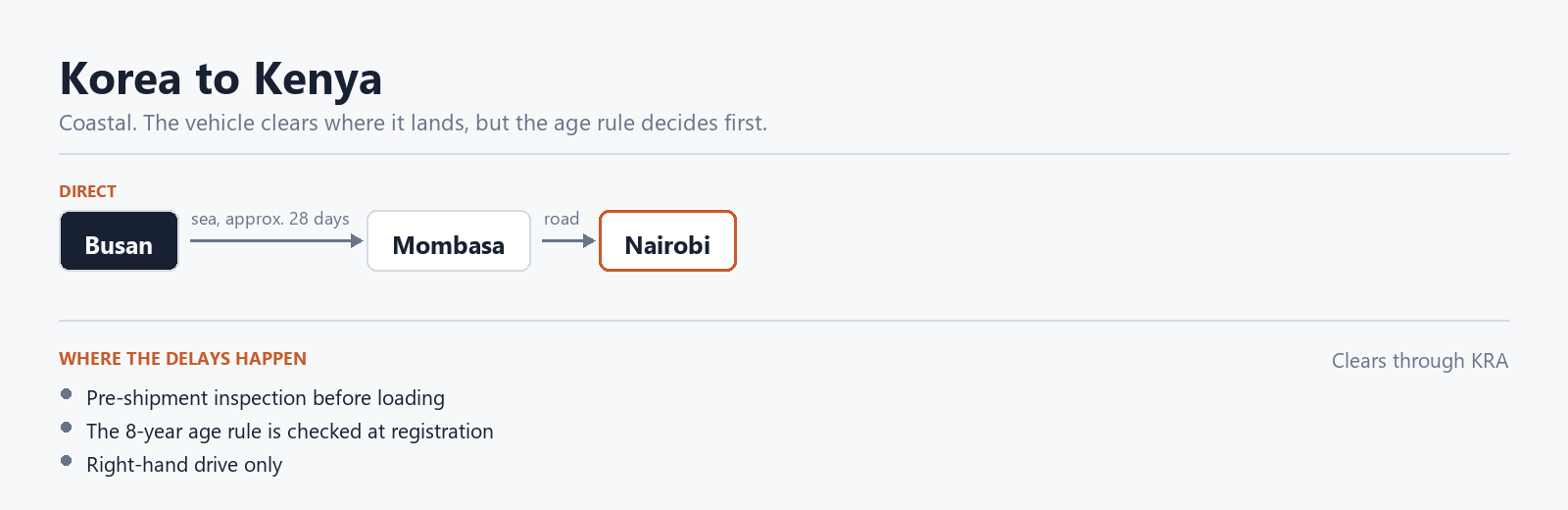
If you are sourcing a used vehicle in Korea for import into Kenya, one rule shapes every sourcing decision before you even look at a car’s condition or price: the 8-Year Statutory Vehicle Requirements (SVR) age cap.
Get it wrong and the Kenya Revenue Authority (KRA) will reject your shipment at Mombasa Port, you will pay demurrage at the port’s Kilindini Waterway, and the vehicle will be re-exported at your expense.
This guide breaks down exactly what the SVR says, how it intersects with Korean auction grades, and what paperwork your Korean supplier must have ready before the vessel leaves Busan.
The short version
- ;s SVR (currently set under the East Africa Community Customs Management Act and enforced by KRA under Customs & Excise Notice) prohibits the importation of used motor vehicles older than eight years from the year of first registration.
- — grade vehicles on a combined body-and-mechanical scale, most commonly the ECAR system: interior grade (1–5) and exterior grade (R to 5, where R means repaired).
- Kenya is a right-hand drive (RHD) market under the Traffic Act.
- No used vehicle enters Kenya without a valid KEBS PVoC Certificate of Conformity (CoC).
What does Kenya’s SVR actually say?
Kenya’s SVR (currently set under the East Africa Community Customs Management Act and enforced by KRA under Customs & Excise Notice) prohibits the importation of used motor vehicles older than eight years from the year of first registration. The calculation is simple but the enforcement is strict:
- If the first registration date on the Japanese or Korean title is January 2017 or earlier, the vehicle is ineligible for Kenya import as of 2026.
- The cutoff resets on 1 January each year.
- The vehicle’s manufacture year is not the controlling date — first registration is. A 2017-model vehicle registered in December 2017 would clear; the same physical vehicle registered in January 2016 (sometimes done for auction lot purposes) would not.
For Korean-sourced stock specifically, the first-registration date appears on the Korean vehicle registration certificate (자동차등록증) and is always verified against the KBA (Kenya Bureau of Accreditation) approved pre-export inspection report.
Discrepancies between the certificate date and the auction record date have caused KRA holds at Mombasa — flag any mismatch to your Korean exporter before cargo is loaded.
How does the SVR limit which Korean units you can buy?
Korean used vehicle auctions — the manufacturer-run auction lanes, a manufacturer-run auction house Auto One, and regional dealer auction sites like the Korean domestic listing market and the large domestic dealer chains — grade vehicles on a combined body-and-mechanical scale, most commonly the ECAR system: interior grade (1–5) and exterior grade (R to 5, where R means repaired).
A grade 4/4 is clean and retail-ready; grade 2/2 means visible body damage and visible interior wear.
The SVR does not filter by grade — KRA does not require a minimum condition rating at the border.
However, KEBS (Kenya Bureau of Standards) PVoC (Pre-export Verification of Conformity, administered by the QISJ — Quality and Inspection Services Japan/Korea) does inspect vehicles for roadworthiness and emissions compliance at origin.
Vehicles with frame damage, structural repairs, or airbag non-deployment records are flagged and require additional QISJ inspection holds that can add 15–20 working days at the Korean port before loading.
Practical sourcing rule: target exterior grade 3.5 or above for Kenya-bound stock. Grade 3 with a structural repair record (accident history listed on the Carhistory Korea 카히스토리 report) is a QISJ red flag. Grade 2 is only viable for parts buyers, not roadway registration in Kenya.
Does Korea have right-hand-drive stock for Kenya?
Kenya is a right-hand drive (RHD) market under the Traffic Act. Korean domestically-registered vehicles are left-hand drive (LHD) as standard — South Korea drives on the right. This means Korea is not a natural direct source for RHD Kenya-bound stock the way Japan is.
There are two paths Korean exporters use to supply the Kenya corridor:
Path 1 — Japan-Korea re-export. Some Korean exporters source RHD vehicles originally from Japanese auctions (the Japanese auction system Nagoya, JAA Osaka, AUCNET Japan) and process them through Korean bonded warehouses in Pyeongtaek or Incheon before re-exporting. The paperwork origin is Korean but the vehicle title history is Japanese.
Buyers must verify the original Japanese shakken (車検) certificate is included, not just the Korean export declaration. The QISJ Kenya program checks both.
Path 2 — LHD conversion for select models. A small number of models are available in factory-built RHD from Korean production runs for export markets (Kia Sportage NQ5 RHD was produced for Australia and Malaysia; some units return to Korean gray-market auctions).
These are rare and command a 12–18% premium over identical LHD units at Korean auction.
For most Kenya buyers, Japanese-sourced stock through a Korean consolidator is the practical route. Confirm explicitly with your Korean exporter whether the vehicle was originally Japanese-registered or Korean-registered, and request the full title chain.
What is the KEBS PVoC certificate?
No used vehicle enters Kenya without a valid KEBS PVoC Certificate of Conformity (CoC). For vehicles sourced from Korea, the approved inspection body is QISJ (Quality and Inspection Services Japan & Korea, offices in Busan and Incheon). The PVoC process:
- Pre-booking: QISJ inspection is booked 5–7 working days before the vessel departure date. Do not book after cargo is loaded — late requests are rejected.
- Physical inspection: QISJ inspectors examine the vehicle at the Korean export yard. They verify: VIN against documents, RHD configuration, headlight pattern (European pattern headlights for LHD are rejected for RHD markets), odometer versus service history, and emissions compliance against Euro 4 minimum (Euro 4 has been Kenya’s floor since 2022).
- Certificate issuance: If clear, KEBS PVoC CoC is issued within 3 working days. This document must accompany the Bill of Lading and be presented to KRA at Mombasa on arrival.
- Rejection path: A rejected vehicle can be re-inspected once repairs are completed, but re-inspection adds 10–15 working days and requires an additional QISJ fee (approximately USD 90–120 per vehicle as of early 2026).
Exporter tip for your SK AutoSphere dealer contact in Korea: include the QISJ booking confirmation number in the deal confirmation email.
Buyers have been burned by Korean exporters who delay PVoC booking until after Nairobi payment clears — by then vessel slots are gone and demurrage starts accumulating at Busan New Port (Gamman Terminal, berths 3–6 for roll-on/roll-off).
How much duty does KRA charge at Mombasa?
Once the vessel arrives at Mombasa Port (Kilindini Waterway), KRA Customs processes the declaration under the East African Community Common External Tariff. For passenger vehicles (HS Code 8703):
- Import Duty: 25% of CIF (Cost + Insurance + Freight) value
- Excise Duty: 20% of (CIF + Import Duty) for engine capacity 1,500cc–3,000cc; 35% for above 3,000cc
- VAT: 16% on (CIF + Import Duty + Excise Duty)
- IDF (Import Declaration Fee): 3.5% of CIF value, minimum KES 5,000
- RDL (Railway Development Levy): 2% of CIF value
A sample landed cost for a 2020 Kia Sportage (NQ5, 2.0L petrol, CIF Mombasa USD 12,000):
– Import Duty: USD 3,000
– Excise Duty: USD 3,000
– VAT: USD 2,880
– IDF: USD 420
– RDL: USD 240
– Total taxes and fees: ~USD 9,540 → landed cost approximately USD 21,540 before clearing agent fees
KRA enforces customs values against the CRSP (Current Retail Selling Price) database, which is updated quarterly and sourced from NTSA (National Transport and Safety Authority) market data. If your CIF declaration is more than 15% below CRSP, KRA will uplift the duty base to CRSP.
Negotiate your Korean invoice value with this in mind — undervaluing to reduce duty is a known compliance trigger.
How do you register a vehicle with NTSA?
After KRA duty payment and release, the vehicle must be registered with NTSA (National Transport and Safety Authority) before it can be plated and driven. NTSA requires:
- Original KEBS PVoC Certificate of Conformity
- KRA Entry / Custom Release Order
- Original foreign title / export certificate (Korean 말소사실증명서 — deregistration certificate)
- Bill of Lading
- Insurance cover note (Kenyan insurer, minimum third-party)
NTSA processing is currently 5–10 working days in Nairobi or Mombasa branch. The deregistration certificate (말소사실증명서) is issued by the Korean district office (구청) where the vehicle was last registered and must be apostilled for Kenyan use.
Some Korean exporters omit this step — confirm it is included in your purchase agreement as a delivery condition.
What should you tell your exporter before signing?
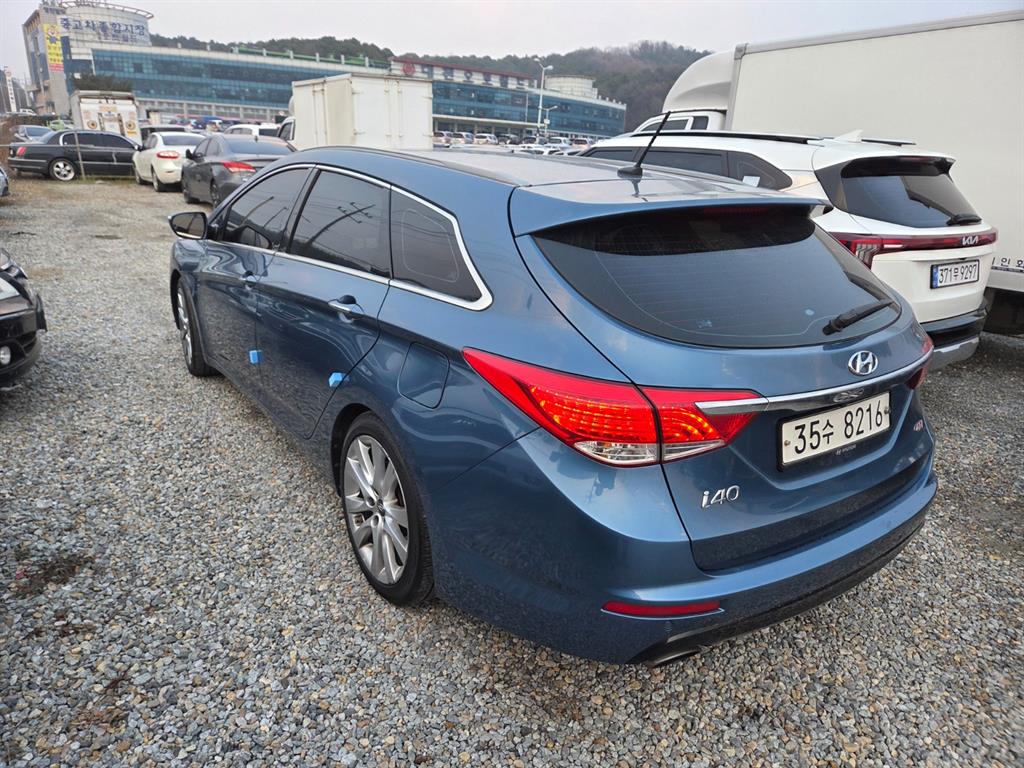
When sourcing through a Korean exporter or via SK AutoSphere’s Korea-to-Africa export pipeline, confirm these before payment:
- First registration date (자동차등록증 issue date) is 2018 or later for 2026 Kenya import.
- RHD configuration confirmed — or full Japanese title chain provided if via re-export.
- Carhistory Korea (카히스토리) report included, showing no structural flood or frame damage.
- QISJ PVoC inspection pre-booked at least 7 days before vessel departure.
- 말소사실증명서 (deregistration certificate) apostilled and included in shipping documents.
- B/L issued on CIF basis with a Kenyan-approved freight insurer — do not accept FOB-only quotes if you want duty predictability.
The 8-year SVR rule is not going away; Kenya has discussed lowering it to 5 years to reduce older stock congestion, and the EAC has proposed regional harmonisation toward a stricter floor.
If you are building a steady Kenya supply pipeline, target 2019-year-of-registration vehicles and newer today — that gives you margin as the rule tightens and demand for compliant stock increases.
This guide is for buyer education only. Import regulations change; verify current KEBS, KRA, and NTSA requirements before shipping. All duty calculations are illustrative based on publicly available EAC CET rates as of 2026.
Sourcing Korean stock for your next container? Tell us the destination port, the model year you are targeting and the spec, and we come back with matched units and a landed figure per unit. Start at SK AutoSphere, or browse the parts catalogue.