Nigeria Used Vehicle Import Playbook: Form M, PAAR, SONCAP, and What Your Korean Supplier Must Have Ready Before the Vessel Leaves Busan
Most Nigerian importers who lose money on Korean vehicle shipments do not lose it at the auction stage.
They lose it at Apapa — waiting for a document that should have been issued in Busan three weeks earlier, watching demurrage tick up at roughly ₦120,000–180,000 per day per container while a Customs officer waits for a SONCAP certificate that the Korean shipper “forgot to mention.”
This guide covers the four documents that determine whether your shipment clears in days or sits rotting at Tin Can Island for a month: the Central Bank of Nigeria Form M, the Nigeria Customs Service Pre-Arrival Assessment Report (PAAR), the SONCAP/PVOC conformity certificate, and the Korean Certificate of Origin issued by the Korea Chamber of Commerce and Industry (KCCI).
Miss any one of them, and the others will not save you.
The short version
- The single most common mistake Nigerian importers make is treating the import documentation as something they manage from their end.
- The Form M is a pre-import declaration issued through an authorised dealer bank in Nigeria.
- The Standards Organisation of Nigeria Conformity Assessment Programme (SONCAP) requires that regulated products — including motor vehicles — be certified by an approved inspection body before export from the country of origin.
- The Certificate of Origin issued by the Korea Chamber of Commerce and Industry (KCCI) is a Customs document that declares the country of manufacture.
Why does the paperwork start in Korea, not Lagos?
The single most common mistake Nigerian importers make is treating the import documentation as something they manage from their end. By the time the vessel sails from Busan New Port’s Gamman Terminal, your window for most corrective action has already closed.
The Nigeria Customs Service’s PAAR system requires that assessment be completed within 48 hours of vessel arrival.
That means your agent needs the full document set — commercial invoice, bill of lading, SONCAP certificate, packing list, and combined certificate of value and origin — before the ship docks at Apapa or Tin Can Island.
If your Korean supplier sends a corrected invoice after the ship has already arrived, you are in a grey zone that typically costs between two and four additional working days of clearing time, plus unofficial fees that no one will document.
The document chain works backwards from the port:
1. CBN Form M opened → triggers PAAR eligibility
2. PAAR submitted → NCS issues assessment before vessel arrival
3. SONCAP certificate lodged → NCS releases for physical examination
4.
KCCI CoO presented → qualifies for any applicable trade preferences and confirms origin for Customs tariff classification
If step 1 happens after the cargo sails, everything downstream compresses into an emergency and you pay for that compression.
Step 1: CBN Form M — Open It Before the Cargo Moves
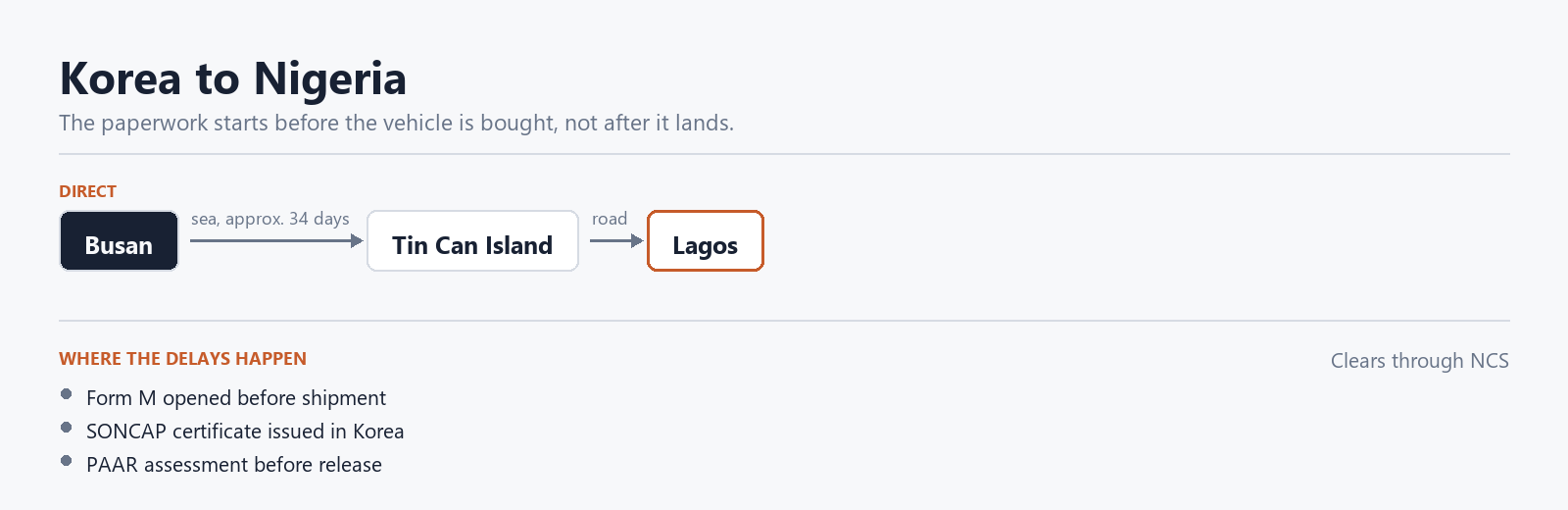
The Form M is a pre-import declaration issued through an authorised dealer bank in Nigeria. It is governed by the Central Bank of Nigeria’s trade finance guidelines and must be opened against a valid pro-forma invoice from your Korean supplier before the goods are shipped.
For used vehicles sourced from platforms, or through a licensed Korean export agent, your pro-forma invoice needs to specify:
– HS Code: 8703 (motor cars and other motor vehicles principally designed for transport of persons) — sub-code depends on engine displacement
– Vehicle identification number (VIN/Chassis number)
– Model year, make, and model (e.g., Hyundai Tucson NX4 2022, Kia Sportage NQ5 2022)
– CIF value in USD (Cost, Insurance, Freight to the Nigerian port of entry — Apapa or Tin Can Island)
Your bank will assign a Form M number. The Nigerian supplier should give this number to the Korean freight forwarder, who will include it on the bill of lading. Without it, NCS cannot process the PAAR.
Practical note: Form M processing at most Nigerian banks takes 2–5 working days. Budget for this before your Korean supplier books the vessel.
Step 2: SONCAP / PVOC — The Certificate That Stops Containers at the Gate

The Standards Organisation of Nigeria Conformity Assessment Programme (SONCAP) requires that regulated products — including motor vehicles — be certified by an approved inspection body before export from the country of origin.
For vehicles shipped from Korea, the approved bodies include Bureau Veritas, Intertek, and SGS, operating under the SON’s Product Verification of Conformity (PVOC) scheme.
Your Korean supplier or freight agent must arrange a SONCAP inspection in Korea before the vehicle is loaded. The inspector verifies that the vehicle meets the relevant Nigerian Standard (NIS) and issues a PVOC Certificate of Conformity.
This certificate then travels with the shipment and must be presented at Customs in Nigeria.
What happens without it: NCS quarantines the shipment pending a destination inspection by a SON-appointed inspector in Nigeria. Destination inspection is more expensive, takes longer (typically 5–14 additional working days at the port), and occurs while the container is accruing demurrage.
At Apapa, demurrage starts at the shipping line’s free time expiry — often 7 days from port arrival — after which fees accumulate daily.
For a single container of 2–3 vehicles, a SONCAP pre-shipment inspection in Korea costs approximately USD 350–600. A destination inspection plus demurrage delay at Apapa can cost multiples of that.
What to confirm with your Korean agent before booking:
– Is the specific vehicle model and year covered under the PVOC scheme?
– Which inspection body will issue the certificate and in which city?
– How many working days from inspection booking to certificate issuance? (Typically 3–7 days from Busan or Incheon)
Step 3: KCCI Certificate of Origin — More Than a Formality
The Certificate of Origin issued by the Korea Chamber of Commerce and Industry (KCCI) is a Customs document that declares the country of manufacture. For most used Korean vehicles — Hyundai Tucson, Kia Sportage, Kia Staria, Hyundai Porter II, Kia Bongo III — this is straightforwardly Korea.
The KCCI CoO matters for three reasons in the Nigeria context:
-
HS Code verification: NCS Customs officers use the CoO to confirm that the vehicle matches its declared HS 8703 sub-heading. A mismatch between the CoO description and the commercial invoice description triggers a query that can hold clearance for days.
-
Anti-dumping / origin verification: NCS has ongoing enforcement interest in verifying that re-exported vehicles (vehicles that passed through a third country like UAE or Japan before Korea) are not being declared as Korean-origin to avoid scrutiny.
-
Future trade agreements: As ECOWAS-Korea trade discussions evolve, a verifiable KCCI CoO is the document that will unlock any preferential rate. Getting into the habit of requesting it now is low-cost.
KCCI CoOs are issued in Seoul and can usually be obtained by a licensed Korean export agent within 2–3 working days.
Step 4: PAAR — Submit It Before the Ship Arrives
The Pre-Arrival Assessment Report is generated by the Nigeria Customs Service Trade Modernisation Project system (formerly ASYCUDA World / now the Nigeria Integrated Customs Information System, NICIS II).
Your licensed Customs agent submits the import declaration using the full document set (Form M number, commercial invoice, bill of lading, SONCAP certificate, CoO, packing list), and NCS pre-assesses the duty liability before the vessel arrives.
Once NCS issues the PAAR, it specifies:
– Customs value (CIF basis)
– Applicable import duty rate (under HS 8703 — rates vary by engine displacement; confirm with your Customs agent for the specific sub-heading)
– VAT (7.5% of CIF)
– ECOWAS Levy (0.5% of CIF)
– Surcharge and other levies per the current Customs tariff schedule
Your agent uses the PAAR to pay duties before the vessel berths. With duties paid and PAAR in hand, NCS physical examination at the terminal is typically completed within 24–48 hours.
Without PAAR pre-assessment — because the document set was incomplete — your agent starts the declaration process after the ship arrives, and the clock on demurrage is already running.
Practical note on Apapa vs Tin Can Island: Experienced importers often prefer Tin Can Island Port for used vehicle imports because it typically has shorter vessel queuing times and somewhat less port congestion than the main Apapa terminal. Your freight forwarder can advise on current berth availability when booking.
What must your supplier confirm before loading?
Print this and send it to your Korean agent or SK AutoSphere sourcing contact before every shipment:
- [ ] Commercial invoice with VIN, HS Code 8703 sub-heading, CIF value in USD, and CBN Form M number
- [ ] Pro-forma invoice matching the commercial invoice (needed for Form M opening)
- [ ] Bill of lading with Form M number annotated, consigned to your clearing agent
- [ ] SONCAP/PVOC Certificate of Conformity (issued by Bureau Veritas, Intertek, or SGS Korea)
- [ ] KCCI Certificate of Origin
- [ ] Packing list with VIN, weight, and container number
- [ ] Vehicle export certificate / deregistration certificate from Korea (required to confirm the vehicle is legally exportable)
Missing any single document means your agent cannot complete the PAAR submission. That delay starts at Apapa the moment the ship berths.
What This Means If You Buy Through SK AutoSphere
When you source a vehicle through SK AutoSphere, the Korean dealer side of this paperwork — the SONCAP inspection arrangement, the KCCI CoO, the correctly formatted commercial invoice — is coordinated as part of the export preparation process.
Buyers who source independently from the Korean domestic listing market without a local Korean export agent are responsible for confirming each of these items themselves, typically through a Korean freight forwarder who charges a handling fee per document.
The practical advantage of a managed export channel is not the vehicle selection — used Hyundai Tucson NX4 and Kia Sportage NQ5 units are available on both. It is the elimination of the single most expensive variable in the import equation: the Apapa demurrage clock starting before your documents arrive.
Summary
| Document | Who prepares it | When it must be ready |
|---|---|---|
| CBN Form M | Your bank in Nigeria (you initiate) | Before cargo is shipped from Korea |
| SONCAP/PVOC CoC | Korean inspection body (arranged by your Korean agent) | Before vehicle is loaded onto vessel |
| KCCI Certificate of Origin | KCCI via your Korean export agent | Before or at time of loading |
| Commercial Invoice + B/L | Korean supplier / freight forwarder | At time of loading |
| PAAR | Your Nigerian Customs agent | Submitted with full docs; ideally 48+ hours before vessel arrival |
The Nigeria import process rewards importers who manage it from the Korean side. Every document above can be confirmed, corrected, or expedited while the vehicle is still in a yard in Busan. None of them can be corrected quickly once the container is at Apapa.
This guide covers the standard Nigeria Customs Service process as of mid-2026. Duty rates, levies, and document requirements are subject to change; confirm current tariff sub-headings and rates with a licensed Nigerian Customs agent before each shipment.
Sourcing Korean stock for your next container? Tell us the destination port, the model year you are targeting and the spec, and we come back with matched units and a landed figure per unit. Start at SK AutoSphere, or browse the parts catalogue.