Importing Korean Used Vehicles into Uganda: The Malaba Corridor Playbook for 2026
Uganda’s used-vehicle market is one of East Africa’s most active — Kampala’s Kiseka Market and the bonded warehouses along Jinja Road turn over thousands of units a year, many of them re-exported onward to South Sudan, eastern DRC, and Rwanda.
For importers sourcing from Korea, the corridor logic is completely different from West Africa: there is no direct sea route to Uganda. Every vehicle arrives via a transit country, which adds 10–21 days and a layer of customs paperwork most Korean exporters have never touched.
This guide covers the full import pathway from Busan to Kampala in 2026: the two viable port routes, Uganda Revenue Authority duty structures, the Uganda National Bureau of Standards pre-shipment requirement, the 8-year age cap mechanics, and the operator-level friction points that separate a smooth clearance from a container sitting at Malaba for three weeks.
The short version
- the Japanese export platforms have dominated the Ugandan used-car market for over a decade.
- Route 1: Busan → Mombasa → Northern Corridor (Primary) RORO vessels from Busan (or Pyeongtaek) call at Mombasa Port roughly every 14–18 days.
- Uganda applies the EAC Common External Tariff (CET) to vehicles.
- Uganda’s UNBS enforces a maximum vehicle age of 8 years from the year of manufacture at the time of importation.
Why source from Korea rather than Japan for Uganda?
the Japanese export platforms have dominated the Ugandan used-car market for over a decade. They still do.
But Korean auction inventory has shifted the calculus on specific segments: the Hyundai Tucson NX4 (2021–2024), Kia Sportage NQ5, and Hyundai Grand Starex TQ are now competitively priced against equivalent Japanese alternatives, with one key advantage — Korean auction grade sheets follow a standardized format that the Uganda National Bureau of Standards (UNBS) inspection officers recognise and can cross-reference against the manufacturer VIN.
At Korean auctions, a Tucson NX4 2.0 MPi (2022, Grade 4, 42,000–55,000km) was trading at ₩13.5M–₩15.5M FOB Busan in Q2 2026.
Landed cost to Kampala on a RORO groupage slot runs approximately $2,800–$3,400 (Busan to Mombasa) plus $850–$1,100 Mombasa-to-Kampala inland transport, before URA duties. For buyers sourcing at volume, this undercuts equivalent Japanese mid-grade by 8–12% on a total-landed basis.
What are the two routes from Busan to Kampala?
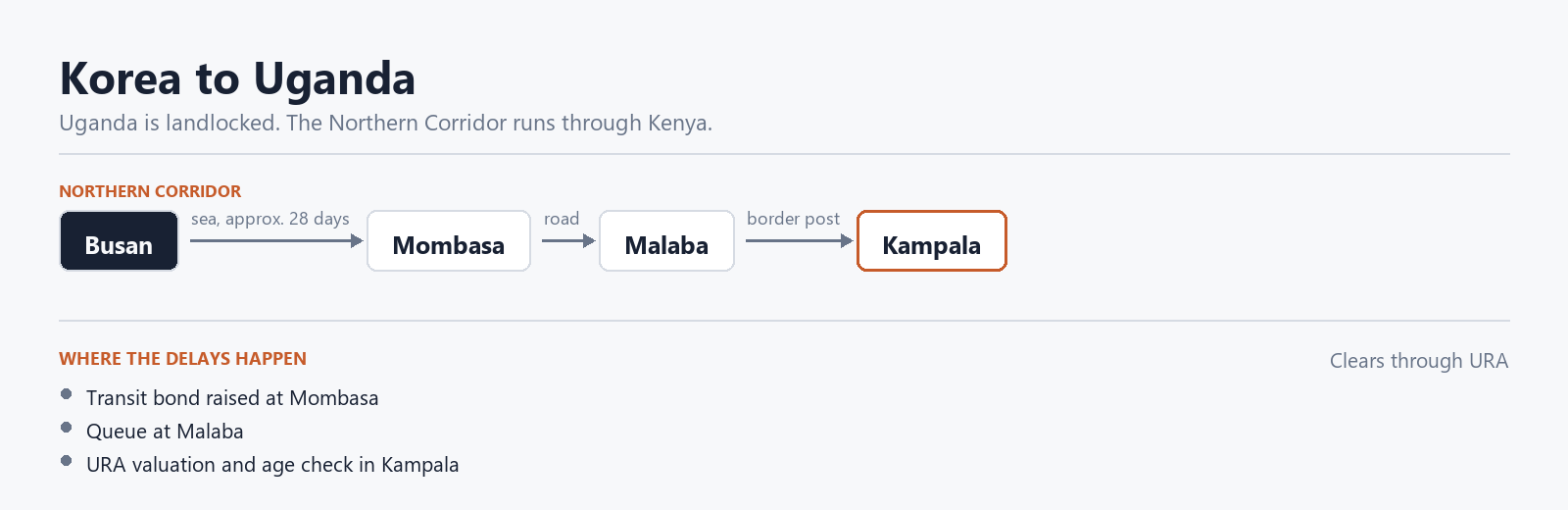
Route 1: Busan → Mombasa → Northern Corridor (Primary)
RORO vessels from Busan (or Pyeongtaek) call at Mombasa Port roughly every 14–18 days. Services operated by Grimaldi and Bahri Nile (via Bahri Yanbu transhipment) both serve the Mombasa RORO berth at Kilindini Harbour. Transit time Busan → Mombasa: 21–28 days.
On discharge at Mombasa, your transit entry is filed through EACS (East African Customs System) for a transit bond to Uganda. The standard route is: Mombasa ICD or direct discharge → Nairobi → Malaba One-Stop Border Post (OSBP) → Busia → Jinja → Kampala.
Road transit from Mombasa to Kampala via Malaba runs 7–14 days depending on transporter and border dwell time.
Malaba OSBP: The Malaba One-Stop Border Post, operated jointly by Kenya Revenue Authority and Uganda Revenue Authority, was designed to cut clearance time below 24 hours. In practice, commercial vehicle clearance (cars under transit bond) runs 1–4 days.
During peak import cycles (November–January), dwell times have historically stretched to 6–10 days. The bottleneck is URA’s physical inspection queue, not paperwork processing.
Route 2: Busan → Dar es Salaam → SGR + Road (Secondary)
Via Tanzania’s Dar es Salaam port, the onward route uses the Tanzania-Zambia Railway Authority (TAZARA) corridor or direct road transport through Dodoma and Mutukula border crossing. Transit Dar → Kampala via road: 12–18 days.
This route is viable when Mombasa is congested or when you’re co-shipping with Tanzania-bound inventory and want to split a container.
For most Korea-Uganda vehicle importers in 2026, Mombasa remains the default. The SGR leg (Dar es Salaam to Dodoma) is underutilised for vehicles and adds handling complexity.
How does URA calculate import duty?
Uganda applies the EAC Common External Tariff (CET) to vehicles. The duty base is CIF (cost + insurance + freight) to the Uganda border, not FOB Korea. This distinction matters: every dollar of your Mombasa-to-Kampala freight bill is included in the dutiable value.
For a passenger vehicle (HS code 8703):
| Levy | Rate | Applied On |
|---|---|---|
| Customs Duty | 25% | CIF value |
| VAT | 18% | CIF + Customs Duty |
| Infrastructure Levy | 1.5% | CIF value |
| Withholding Tax | 6% | CIF value (if importer is not a VAT-registered trader) |
For a Tucson NX4 2.0 at $7,500–11,500 CIF Kampala:
– Customs Duty: $1,500–3,000
– Infrastructure Levy: $110–180
– Subtotal post-duty: $9,000–15,000
– VAT (18%): $1,500–3,000
– Total URA liability: ~$3,500–6,000 on a $7,500–11,500 CIF value
Effective landed duty burden runs 45–55% of CIF on standard passenger vehicles. There is no sub-engine-size duty break equivalent to Ghana’s 10% differential for sub-2L engines. Uganda applies the same 25% across petrol engine sizes.
Excise duty applies to some vehicle categories: check the Uganda Tax Procedures Code Act for current rates on engine displacement above 2,000cc.
What is Uganda’s 8-year age cap?
Uganda’s UNBS enforces a maximum vehicle age of 8 years from the year of manufacture at the time of importation. For 2026 imports, this means vehicles manufactured in 2018 or later are eligible.
In practice, UNBS calculates from the vehicle’s year of manufacture as stated on the Manufacturer’s Certificate of Origin (MCO) or Japanese Auction Sheet / Korean COSS (Certificate of Shipment Summary), not from the registration year.
Korean auction vehicles typically show manufacture date on the Vehicle Inspection Certificate issued by the Korea Transportation Safety Authority (TS) — this document carries weight with UNBS inspectors.
Why this matters for Korean sourcing: Korean auction inventory in 2026 is heavily weighted toward 2018–2023 model years, which sit comfortably inside the 8-year window.
The same constraint is increasingly tight on Japanese inventory in budget segments (many 2017 and earlier units), which is one driver pushing Ugandan importers toward the Korean pool.
What does UNBS pre-shipment inspection involve?
The Uganda National Bureau of Standards requires a Pre-Export Verification of Conformity (PVoC) inspection for vehicles entering Uganda. For Korean-origin vehicles, the designated inspection body is either Bureau Veritas or Intertek — both operate in Korea and can inspect at the port of loading (Busan, Incheon).
What UNBS inspectors verify:
– Vehicle age compliance (8-year cap)
– Roadworthiness and safety systems (airbags, seat belts, ABS)
– Emission standards compliance (Euro 4 equivalent minimum)
– VIN matches documentation (critical — Korean auction vehicles sometimes have scrubbed VINs on export paperwork)
The PVoC inspection adds $150–$280 per vehicle and 3–5 working days to Busan pre-shipment preparation. Do not skip it: vehicles arriving at Mombasa or Malaba without a UNBS PVoC certificate are subject to destruction or compulsory re-export. URA and UNBS cross-reference PVoC certificate numbers at point of entry.
What documents do you need to import from Korea to Uganda?
| Document | Source | Notes |
|---|---|---|
| Bill of Lading | Shipping line | Must show RORO vessel name and voyage number |
| Korean COSS (Export Certificate) | Korean dealer / auction house | Proves legal export from Korea |
| Original Title (Automobile Deregistration Certificate) | Seller | If dealer-sourced; not always available for auction vehicles |
| Korea TS Inspection Certificate | Korea Transportation Safety Authority | Age and roadworthiness evidence for UNBS |
| PVoC Certificate | Bureau Veritas / Intertek | Mandatory for UNBS clearance |
| Marine Insurance Certificate | Your insurer | CIF basis — URA requires proof of insurance in the duty calculation |
| Commercial Invoice | Your supplier | Must state CIF value to Uganda border |
| Packing List | Your supplier | Required for EACS transit entry |
| EACS Transit Bond | Filed at Mombasa by clearing agent | Covers vehicle in transit through Kenya |
What actually goes wrong on the Uganda corridor?
1. Malaba OSBP dwell time is unpredictable. Budget for 4 days, plan for 10. If you have a buyer waiting, do not promise a delivery date based on the OSBP’s official 24-hour target. The queue for URA physical inspection of RORO vehicles does not operate on a fixed schedule.
2. Transit bond recovery from Kenya Revenue Authority. When your vehicle exits Kenya at Malaba, KRA must cancel the transit bond. If the cancellation is delayed (manual process, happens frequently), KRA can pursue the bond guarantor.
Use a clearing agent who works with both a Mombasa-based and a Malaba-based sub-agent so bond cancellation is confirmed same-day.
3. Currency exposure: KRW → USD → UGX. Korean suppliers price in KRW. URA duties are assessed in USD at the Bank of Uganda daily mid-rate on the date of entry. The Ugandan Shilling has a history of short-term volatility against the dollar (5–8% swings within a month).
Lock your USD→UGX rate before the container ships, not after it arrives.
4. Engine capacity documentation. Some Korean dealers list engine displacement in Korean (cc not L) on export documents. UNBS and URA both use L (litres).
A 1,998cc Tucson engine that a Korean supplier documents as “2.0L” is fine; if the document says “1,998cc” and the URA computer rounds it differently, you may trigger a manual review. Ask your Korean supplier to state engine size in L on the commercial invoice.
SK AutoSphere’s Role in the Uganda Corridor
SK AutoSphere sources from Korean auctions including a manufacturer-run auction house, KCA, and a Korean auction house, and provides the pre-shipment documentation package (COSS, TS Inspection Certificate, graded auction report) that UNBS inspectors require.
Every vehicle listed on the platform has an AI-verified condition report cross-referencing auction grade against image analysis, reducing the risk of a condition surprise at Mombasa discharge.
For Ugandan importers buying at volume (3+ vehicles per shipment), the platform offers grouped RORO booking coordination on the Grimaldi and Bahri services out of Busan — consolidating multiple buyers into a single vessel booking reduces per-unit freight cost by 12–18%.
Quick Reference: Uganda Import Numbers
| Item | Figure |
|---|---|
| Customs duty (passenger vehicles) | 25% of CIF |
| VAT | 18% of (CIF + duty) |
| Infrastructure levy | 1.5% of CIF |
| Vehicle age cap (2026 imports) | 2018 year of manufacture or newer |
| PVoC inspection cost | $150–$280/vehicle |
| Busan → Mombasa transit | 21–28 days |
| Mombasa → Kampala road transit | 7–14 days |
| Malaba OSBP dwell (plan for) | 4–10 days |
Current auction data: the Korean domestic listing market auction platform. Duty rates: Uganda Revenue Authority Tariff, EAC CET Schedule VIII. Shipping services: Grimaldi Africa Lines, Bahri Nile. Inspection requirements: Uganda National Bureau of Standards PVoC Programme documentation.
All figures as of Q2–Q3 2026; verify current rates with URA and UNBS before clearing.
Sourcing Korean stock for your next container? Tell us the destination port, the model year you are targeting and the spec, and we come back with matched units and a landed figure per unit. Start at SK AutoSphere, or browse the parts catalogue.