Lomé Port (Togo): The Hidden Gateway for Landlocked West African Vehicle Importers
For buyers in Burkina Faso, Mali, Niger, and northern Ghana moving Korean vehicles inland — the Port Autonome de Lomé offers a different calculus than Tema or Lagos.
When an importer in Ouagadougou is pricing out a 2021 Hyundai Tucson from Busan, the instinct is to route through the nearest coastal hub: Tema in Ghana, roughly 1,000 km south by the N1 highway. That instinct costs money.
The Port Autonome de Lomé (PAL) in Togo — 1,200 km by road but faster in practice — has become the preferred corridor for experienced operators importing to Burkina Faso, Mali, and Niger because of three structural advantages: a deepwater terminal designed for vehicle roll-on/roll-off (RoRo) traffic, a dedicated transit bond regime that clears in days rather than weeks, and the lowest dwell cost per day among the three main West African vehicle-import hubs.
This guide explains the Lomé transit route in operator terms — who it works for, what the process looks like from Korea to Ouagadougou or Bamako, what it costs, and where the traps are.
The short version
- Lomé’s container and RoRo terminal is operated under a concession managed by Lomé Container Terminal (LCT), a joint venture majority-owned by MSC (Mediterranean Shipping Company).
- The OTR SYDONIA++ system (Togo’s electronic customs declaration platform) is the operational core.
- This estimate is for planning purposes only — OTR/DGD assessments vary by HS code classification, vehicle age, and declared CIF accuracy.
- As of 2024, Burkina Faso’s DGD enforces a 10-year vehicle age cap on most imported passenger vehicles.
Why route through Lomé?
Lomé’s container and RoRo terminal is operated under a concession managed by Lomé Container Terminal (LCT), a joint venture majority-owned by MSC (Mediterranean Shipping Company).
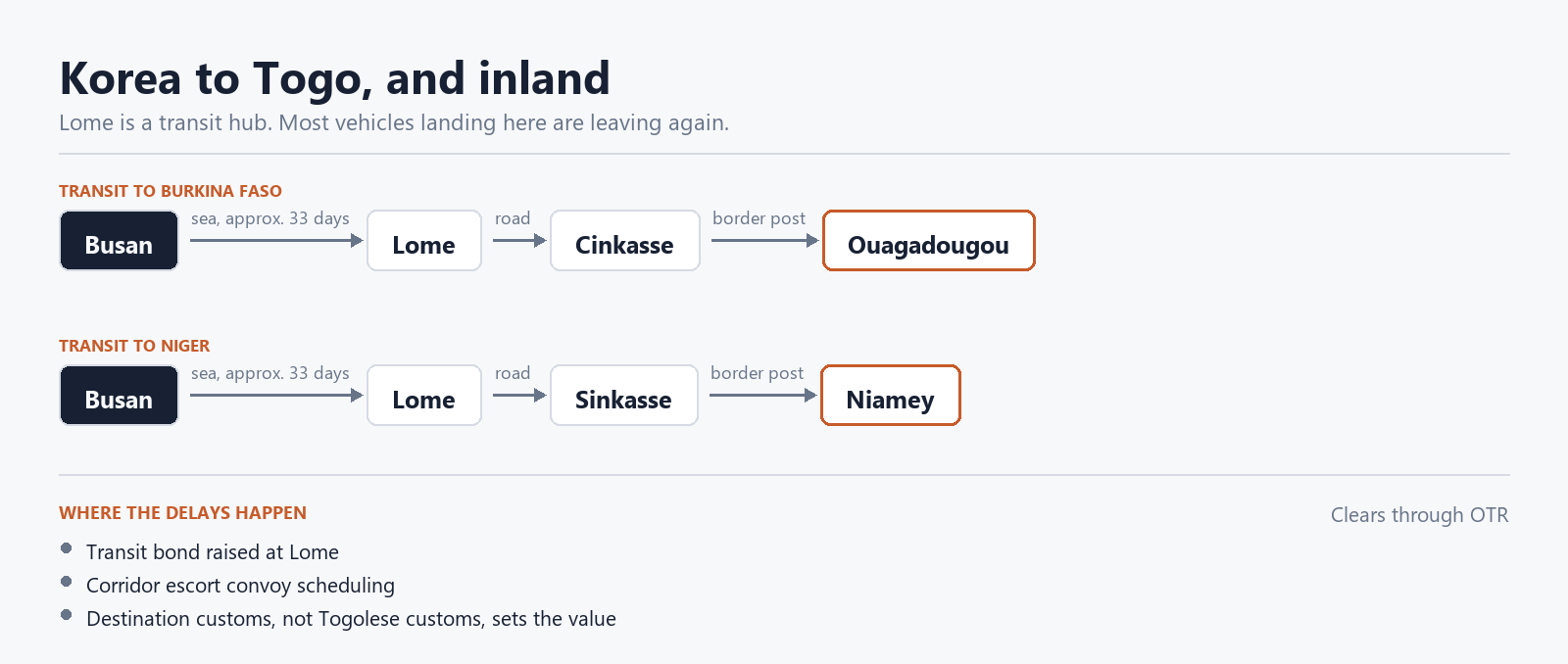
The deepwater berth — 14.5 m draft — handles Wallenius Wilhelmsen, EUKOR, and NYK Auto Logistics regular calls from Busan’s New Port, with typical Busan-to-Lomé transit times of 22–26 days via the standard West Africa loop (through the Cape of Good Hope or the Suez depending on operator).
Critically for landlocked importers, Togo maintains a transit facilitation agreement under ECOWAS and WAEMU frameworks. Under this regime, vehicles cleared as “transit goods” (en route to a landlocked WAEMU member state) attract a transit bond — not the full import duty — while crossing Togo.
The vehicle isn’t technically imported into Togo; it passes through on a guaranteed bond lodged with the OTR (Office Togolais des Recettes), Togo’s revenue authority.
Compare that to the alternative: a vehicle entering via Tema (Ghana) for onward transit to Burkina Faso must navigate Ghana Revenue Authority (GRA) clearance + a separate transit permit system + the Paga or Hamile border crossing.
The paperwork layers add time; the GRA transit system has historically been slower to release for landlocked buyers than Togo’s OTR system, though both have improved since 2023.
How does the transit bond work?
The OTR SYDONIA++ system (Togo’s electronic customs declaration platform) is the operational core. Your licensed Togolese freight forwarder (known locally as a commissionnaire en douane agréé) submits a single transit declaration covering:
- The vehicle’s Korea export documents (Korean customs export declaration / B/L copy)
- Vehicle identification (VIN, year, make, model, engine capacity)
- Country of final destination (e.g., Burkina Faso)
- Transit bond value — typically set at 100–150% of the estimated WAEMU common external tariff (CET) duty that would apply if the vehicle were imported into Togo
The bond is lodged as a cash deposit or bank guarantee. Most established Lomé forwarders (Saga, SOCOPAO, SDV Bolloré Logistics, GETMA) maintain standing bond facilities with OTR, meaning they can post bond on your vehicle in hours rather than waiting for a bank guarantee to clear.
Once bond is posted and SYDONIA++ declares the vehicle in transit, the vehicle exits the port on a transit movement document (TMD) valid for 10 days (extendable by the forwarder for a fee if the truck route to the border takes longer).
The bond is discharged only when the vehicle crosses the Togo-Burkina Faso border at Cinkassé and receives a Burkina customs entry receipt stamped by the Direction Générale des Douanes (DGD).
The trap: if your driver is slow crossing, the bond lapses and OTR treats the vehicle as abandoned-in-transit — triggering a penalty assessment against your forwarder’s standing bond facility. Established forwarders track their transit movements actively.
Avoid Lomé-based small operators who don’t have bond facilities and rely on bank guarantees each time — the timing risk is real.
What does it cost to land a vehicle in Ouagadougou?
For a typical mid-range vehicle (e.g., 2020 Kia Sportage, CIF Lomé value ~$12,000–20,000):
Freight (Busan FOB → Lomé CIF):
– Ocean freight + RoRo surcharges: $1,200–1,800 (Wallenius Wilhelmsen / EUKOR RORO standard West Africa rate)
– Marine insurance: $160–220 (1.0–1.4% of CIF value recommended)
Lomé Port Charges:
– THC (terminal handling charge, PAL): $320–420 per vehicle
– Port storage: minimal if cleared within 5 days of vessel arrival (day 1–5 free under most forwarder agreements); $8–12/day from day 6
– Wharfage: ~$45–65 fixed per vehicle
Togo Transit (not import duty):
– Transit bond lodgement fee (forwarder): $80–150 per vehicle
– SYDONIA++ declaration fee: $50–90
– Transit customs escort (for vehicles above threshold value, OTR may require escort): $0–180 depending on forwarder facility
Inland Road Freight (Lomé → Ouagadougou, ~1,200 km):
– Vehicle-on-trailer (flat-bed): $600–900 depending on fuel prices and route
– Road transit time: 3–5 days (Lomé → Cinkassé border → Ouagadougou via the RN1)
Burkina Faso Import Duties (WAEMU CET basis):
– Passenger vehicles (HS 8703): WAEMU CET 20% + statistical levy 1% + community solidarity levy 0.5% on assessed CIF Burkina value
– Assessed CIF includes the Lomé THC and inland freight — confirmed by DGD Burkina practice since their 2022 CET reform alignment
– On a $12,000–20,000 CIF vehicle: WAEMU CET ~ $2,500–4,000 (20%), total fiscal burden with levies ~$2,500–4,500
Total estimated landed cost (Busan → Ouagadougou): ~$22,500–24,500 for a mid-range SUV at $12,000–20,000 CIF Lomé.
This estimate is for planning purposes only — OTR/DGD assessments vary by HS code classification, vehicle age, and declared CIF accuracy. Get a forwarder quote for your specific VIN before committing.
What is Burkina Faso’s vehicle age limit?
As of 2024, Burkina Faso’s DGD enforces a 10-year vehicle age cap on most imported passenger vehicles. A 2020 Kia Sportage (4 years old at import in 2024) clears comfortably.
A 2012 Hyundai Santa Fe (12 years) does not clear under current rules without a waiver — and waivers for commercial importers are rarely granted.
Korean auction export certificates and the vehicle’s Korean registration document (자동차등록증) are required at the DGD Burkina window. The DGD does not accept auction sheets alone as proof of manufacture date — you need the original Korean registration or an equivalent notarized document.
BIVAC Burkina (Bureau Veritas, operating as the Pre-Shipment Inspection agent for Burkina Faso customs under a government contract) may require pre-shipment inspection at origin (Korea) for vehicles above certain CIF value thresholds.
Confirm current thresholds with your forwarder before the vehicle leaves Korea — BIVAC inspections missed at origin cause holds and additional costs at Burkina customs.
Can you reach Mali through Lomé?
The same PAL transit bond regime works for Mali — vehicles cross at the Togo-Burkina border at Cinkassé, continue to Ouagadougou, then onward to Bamako via the Burkina-Mali border at Heremakono (or Faramana). The inland leg from Lomé to Bamako is 1,600–1,900 km by road and typically takes 6–9 days.
Mali’s Direction Nationale des Douanes (DND) uses its own ASYCUDA system for import declarations. The transit bond discharged at Cinkassé does not carry forward into Mali — your Malian customs agent files a new entry at the Malian border crossing.
This double-transit structure (Togo transit → Burkina transit → Mali import) is complex but well-established. It is the standard route for Korean and Japanese used vehicle importers into Bamako.
Expect one additional week of transit time versus Ouagadougou, and budget an additional $200–400 in Burkina transit road fees and border facilitation costs.
Practical Checklist: Using Lomé as Your Transit Port
Before the vehicle leaves Korea:
– [ ] Confirm vehicle age is within Burkina/Mali destination country limit (Burkina: 10 years; Mali: 8 years per current DND enforcement)
– [ ] Obtain Korean customs export declaration (수출신고서) + original registration document (자동차등록증)
– [ ] Check BIVAC pre-shipment inspection requirement for your destination country and CIF value
– [ ] Book RoRo vessel with Lomé call (Wallenius Wilhelmsen, EUKOR, Grimaldi, or NYK Auto Logistics — all serve Busan–Lomé)
– [ ] Appoint Lomé forwarder with active OTR transit bond facility and standing DGD Burkina contacts
At Lomé port:
– [ ] Forwarder submits SYDONIA++ transit declaration within 24 hours of vessel arrival
– [ ] Bond posted; port storage clock starts — aim to clear within 3 days
– [ ] Vehicle inspection at PAL yard (forwarder present; note any damage on the TMD before departure)
– [ ] Vehicle loaded onto trailer; Transit Movement Document (TMD) issued
At Burkina/Mali border:
– [ ] TMD presented at Cinkassé (or Faramana/Heremakono for Mali)
– [ ] Bond discharge stamp from DGD received — send scan to Lomé forwarder same day to release bond facility
When is Lomé the wrong choice?
Lomé transit works well for landlocked buyers whose destination is Burkina Faso, Mali, or Niger. It does NOT work well for:
- Southern Ghana buyers: Tema is closer and direct import into Ghana is simpler
- Nigerian buyers: Lagos Apapa/Tin Can is the standard route; Togo transit adds unnecessary routing
- Senegal / Dakar buyers: Dakar port has direct Korean car carrier calls; no need for transit via Togo
- High-urgency clearances: The transit bond + double-border process adds 10–18 days vs a direct import country with a local port. If speed matters more than cost, route to a country with a direct port (Ghana, Nigeria, Senegal)
How do you find a Lomé forwarder?
The established logistics operators at PAL with verified Korea-to-West Africa track records include:
- Bolloré Logistics (GETMA Togo) — largest volume at PAL, extensive ECOWAS transit experience
- SAGA Togo — long-established, strong DGD Burkina relationships
- SOCOPAO Togo — active on Korean vehicle shipments via EUKOR/Wallenius
- SDV (formerly DHL Supply Chain West Africa) — global network, useful for higher-value vehicles requiring BIVAC inspection coordination
Request specific references for Korean vehicle transit work — general freight forwarders sometimes underestimate the Korea-specific documentation requirements (auction export certs, self-certification for used vehicles).
Summary: Lomé Route Economics vs Tema Route
| Factor | Lomé via PAL | Tema via GHA |
|---|---|---|
| Port THC (approx.) | $320–420 | $380–480 |
| Transit bond system | OTR SYDONIA++ — bond in hours | GRA transit permit — 2–5 days |
| Road distance to Ouagadougou | ~1,200 km | ~950 km |
| Road time to Ouagadougou | 3–5 days | 4–7 days (border delays at Paga historically longer) |
| Storage cost risk | Low (5-day free period) | Moderate (Tema dwell times higher) |
| Suitable for Mali route | Yes — established | Adds Burkina-Ghana-Mali routing complexity |
For experienced operators moving multiple vehicles per quarter to Burkina Faso or Mali, Lomé becomes the preferred port once the forwarder relationship is established. The bond mechanism is frictionless at scale; the port dwell is lower; and the SYDONIA++ declarations are issued faster than comparable transit documents at Tema.
The first shipment takes longer to set up (forwarder vetting, bond facility confirmation, DGD Burkina contact registration). By the third or fourth shipment, the transit time from vessel arrival at Lomé to vehicle delivery in Ouagadougou should be running 8–12 working days.
This guide covers the routing and process as understood at time of writing. Customs regulations, CET rates, and transit bond requirements change. Always confirm current procedures with your licensed forwarder before shipping.
Sourcing Korean stock for your next container? Tell us the destination port, the model year you are targeting and the spec, and we come back with matched units and a landed figure per unit. Start at SK AutoSphere, or browse the parts catalogue.