Importing Korean Used Vehicles Through Dakar: The Senegal Buyer’s Complete Guide
If you’re sourcing used vehicles from Korea for the Senegalese market, Dakar is your port.
The Port Autonome de Dakar (PAD) handles roughly 90% of Senegal’s vehicle imports, and its customs clearance setup for Korean-origin cargo is well-established — but there are specific steps and cost items that Korean exporters routinely fail to mention upfront.
This guide covers what actually happens from Korea to your hands in Dakar.
The short version
- Korean used vehicles have gained serious traction in Francophone West Africa over the last three years.
- For vehicles, this is conducted by BIVAC Sénégal, the appointed inspection bureau under the Direction Générale du Commerce Extérieur.
- Senegal is a member of the West African Economic and Monetary Union (WAEMU/UEMOA), which applies the Common External Tariff (CET) to all imports from outside the zone.
Why source Korean vehicles for Senegal now?
Korean used vehicles have gained serious traction in Francophone West Africa over the last three years.
Hyundai and Kia’s domestic EV transition has pushed a wave of 2019–2023 ICE vehicles onto the export market, with Grade 4 Kia Sportage NQ5 and Hyundai Tucson NX4 units now available in the ₩13M–₩17M range (approximately $9,700–$12,700 FOB Busan) — pricing that was ₩2M–₩3M higher two years ago.
For Senegalese buyers, the Korea-sourced vehicle hits a different value band than Japanese imports. The Kia Sportage NQ5 (2021–2022) typically arrives with under 50,000 km and the Korean domestic listing market Grade 4 condition.
The equivalent Japanese unit on the Japanese export platforms at similar price points often has 80,000–100,000 km.
That mileage gap matters for resale in Dakar and for buyers in regional secondary markets (Thiès, Kaolack, Saint-Louis).
What is the BIVAC pre-shipment inspection?
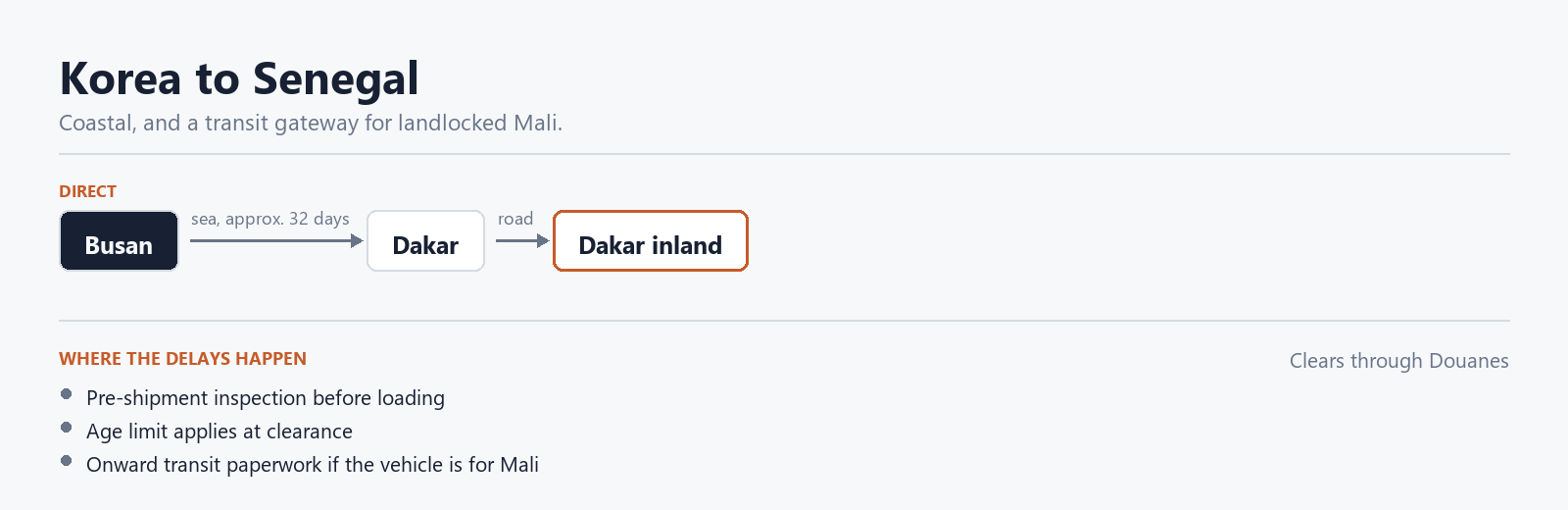
Senegal mandates a pre-shipment inspection (PSI) for all imported goods above FCFA 1,000,000 (approximately $1,000–2,000). For vehicles, this is conducted by BIVAC Sénégal, the appointed inspection bureau under the Direction Générale du Commerce Extérieur.
The key operational point: BIVAC inspection must happen at the origin — in Korea — before the vehicle is loaded. Your Korean exporter or freight forwarder needs to schedule the BIVAC inspector at the Busan yard or port facility before the vehicle is containerized or rolled onto the RoRo vessel.
The inspection cost runs approximately $150–$250 per vehicle (verify against current BIVAC Sénégal fee schedule, as rates are updated). This cost is typically borne by the importer but many Korean exporters quote FOB prices without including it. Negotiate it into the total cost upfront.
What BIVAC checks:
– Vehicle identification (VIN, engine number) against the Korean title/certificate
– General condition vs. stated grade
– Fuel system (no modifications flagged by Senegalese customs)
– Age: Senegal does not impose a hard age restriction on used vehicles, but BIVAC notes age and condition in their inspection certificate
BIVAC issues a Certificate of Conformity (CoC) which is required for customs clearance at Dakar. Without it, the vehicle cannot be cleared — it will be held at the port.
How much duty do you pay at Dakar?
Senegal is a member of the West African Economic and Monetary Union (WAEMU/UEMOA), which applies the Common External Tariff (CET) to all imports from outside the zone. Korea is not a WAEMU member, so Korean-origin vehicles attract the full CET rate.
Used passenger vehicles (HS code 8703) fall in CET Category 4: 20% import duty on CIF (Cost + Insurance + Freight) value.
Additional levies on top of the 20% CET:
– 1% Statistical Fee (redevance statistique) on CIF value — applied to all imports
– 1% Community Solidarity Levy (prélèvement communautaire) — applies to imports from outside WAEMU
– 0.5% ECOWAS Levy — for goods originating from non-ECOWAS countries (Korea qualifies)
– TVA (VAT) at 18% on the CIF value plus applicable duties — this is the largest single cost for commercial importers without VAT recovery capability
Worked example — Kia Sportage NX4 2022 1.6T, Grade 4:
| Item | Amount |
|---|---|
| FOB Busan | $9,000–14,000 |
| Freight (Busan → Dakar, RoRo via Grimaldi) | $500–1,500 |
| Insurance (1.2% of FOB) | $110–170 |
| CIF Dakar | $10,000–16,000 |
| CET duty (20%) | $2,000–3,500 |
| Statistical fee (1%) | $100–160 |
| Community solidarity levy (1%) | $100–160 |
| ECOWAS levy (0.5%) | $50–80 |
| Subtotal before VAT | $12,000–19,000 |
| TVA (18% on CIF + duties) | ~$2,000–3,500 |
| Total landed (incl. VAT) | $36,310–58,870 |
| BIVAC inspection | ~$100–300 |
| Customs agent fees (required) | ~$350–$500 |
| Full landed cost estimate | $36,310–58,870 |
Note: Senegalese customs law requires that customs formalities be handled by a licensed commissionnaire en douane agréé (approved customs clearing agent). You cannot clear a vehicle yourself. Budget $350–$500 for agent fees on top of duties.
What documents does Senegal require?
Dakar customs at the Port Nord and Port Sud offices (the two offices authorised for vehicle clearance) require:
- Commercial invoice from the Korean seller (must state CIF value; FOB invoices are accepted but customs will calculate freight separately)
- Bill of Lading (Connaissement) — original copy required
- Certificate of Origin issued by the Korean Chamber of Commerce (상공회의소) — required for tariff classification
- BIVAC Certificate of Conformity — cannot clear without this
- Korean vehicle title/certificate of deregistration (말소 등록 사실 증명서) — proves the vehicle has been deregistered from Korean registration
- Insurance certificate covering the voyage
- Packing list (for containerized shipment)
- Preliminary Import Declaration (DPI) — required for all imports ≥ FCFA 1,000,000 (~$1,000–2,000); filed before goods arrive
How do vehicles ship from Korea to Dakar?
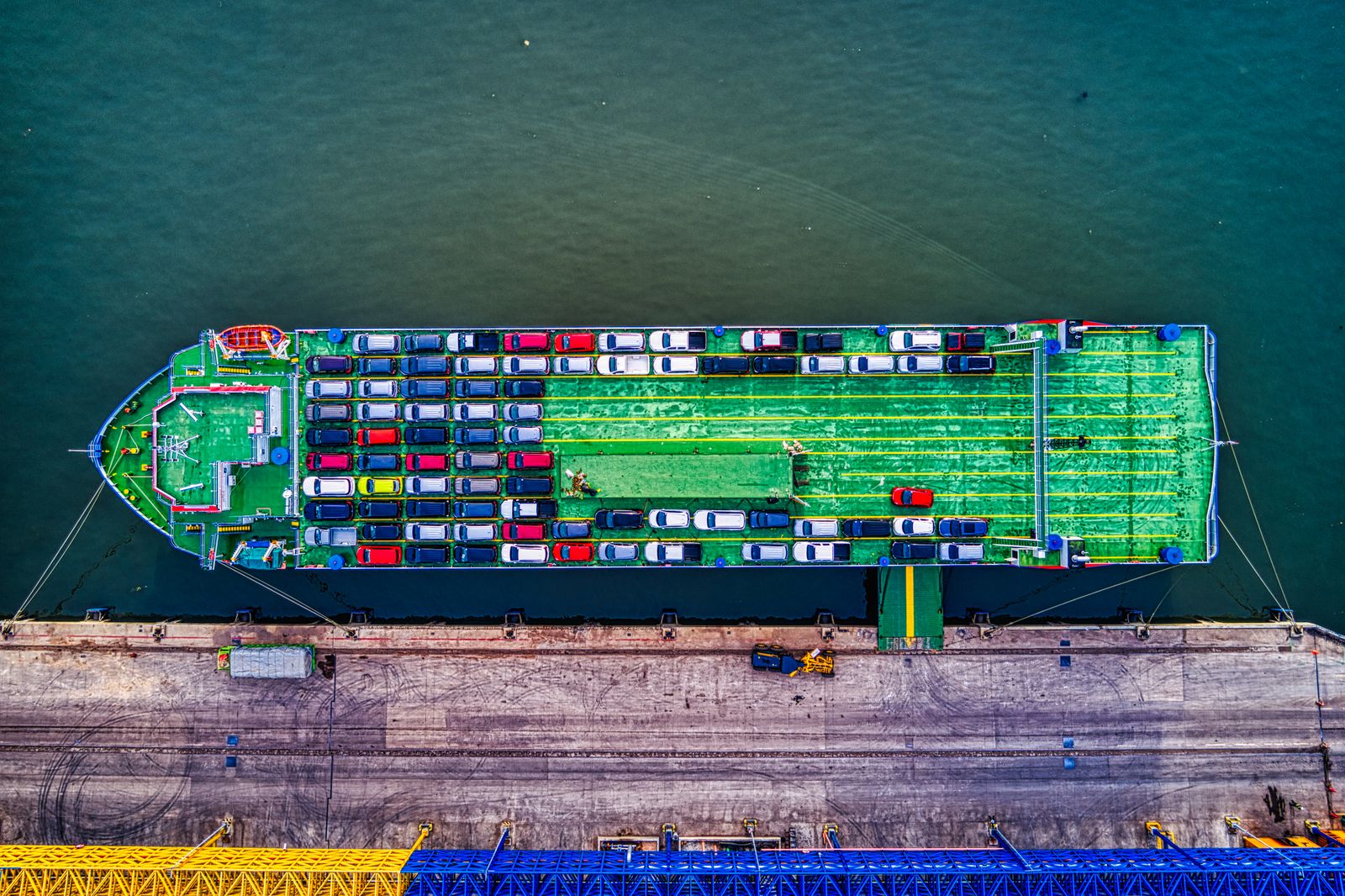
RoRo (Roll-on, Roll-off) — recommended for standalone units:
– Busan → Dakar via Grimaldi Lines (weekly service). Transit: approximately 28–35 days.
– Cost: $1,000–$1,400 per unit depending on vehicle dimensions. Compact SUVs (Sportage, Tucson) are at the lower end.
– Advantage: no containerization cost, lower damage risk from strapping.
Container (20-foot dry) — for 2–3 units or high-value vehicles:
– 20ft container fits 2 standard SUVs (tight) or 1 SUV + 1 compact. 40ft fits 3–4 SUVs.
– Door-to-door cost from Busan to Dakar is approximately $1,800–$2,400 for a 20ft container.
– Advantage: better protection, lower theft risk for individual parts.
For most buyers sourcing 1–3 vehicles, RoRo is the default. Container consolidation becomes viable when buying 5+ units.
How long does clearance take at Dakar?
Typical clearance at PAD customs (Port Nord or Port Sud) for well-documented Korean vehicle shipments:
- Days 1–2: Documents submitted to customs agent; DPI verified; duties assessed
- Days 3–5: Duty payment processed (wire transfer or certified bank check to Treasury)
- Days 5–10: Physical inspection by customs officer if flagged (Grade discrepancy, age, or document mismatch); release otherwise
- Day 5–10: Vehicle released to importer
Delays most commonly arise from:
1. BIVAC CoC absent or mismatched VIN — vehicle held until resolved
2. Korean title not properly apostilled or notarized
3. CIF value understatement flagged by customs — vehicles are compared against customs’ internal reference database
Dakar customs agents know the Korean domestic listing market grade system by sight now. A Grade 3.5 sheet with box W1 repairs (minor paint touchup) on a five-year-old Tucson is a negotiation point on declared value, not a rejection reason.
But a Grade 3 with box R1 (minor accident repair noted) on a vehicle declared in “Excellent” condition on the commercial invoice is a customs red flag that can hold a shipment for weeks.
Rule: Your commercial invoice condition description must be consistent with the Korean domestic listing market or auction grade sheet. Never describe a Grade 3 vehicle as Grade 4 in the invoice.
Practical Tips from Operators
Get the Korean domestic listing market grade sheet in Korean. Dakar-based customs clearing agents who handle Korean vehicle volumes have seen the original 자동차 상태 및 가격조사서 format. A translated summary without the original raises questions.
Factor BIVAC cost at contract stage. Ask your Korean exporter upfront: “Is the BIVAC inspection scheduled and included in your FOB quote?” If not, add $100–300 to your cost model and confirm the BIVAC appointment date.
Verify the deregistration certificate. The Korean 말소 등록 사실 증명서 is essential. Vehicles that are not deregistered in Korea create title complications in Senegal. Any reputable Korean export dealer provides this automatically; ask for it with the other documents.
Use a Dakar-based customs agent with Korean vehicle experience. The clearance process is faster with an agent who has seen the Korean domestic listing market grade sheets before and knows the PAD vehicle customs procedures. Rates are regulated but service quality varies.
Hybrid premium: Senegal does not currently offer a specific duty reduction for hybrid vehicles (unlike Kenya’s hybrid tariff preference). Budget CET at the full 20% regardless of powertrain type.
Bottom Line
Importing Korean used vehicles through Dakar is straightforward when the documentation is right — particularly the BIVAC CoC and the original Korean title/deregistration certificate.
The total landed cost for a well-sourced 2021–2022 Grade 4 Korean SUV typically runs $17,500–$20,000 delivered to your yard in Dakar, depending on the vehicle value and shipping method.
The margin window for retail resale in the Dakar market is real, particularly for the Kia Sportage NQ5 and Hyundai Tucson NX4, where equivalent-condition Japanese units now sell for $21,000–$25,000 retail.
For buyers sourcing their first Korean unit, the BIVAC inspection step and the customs agent requirement are non-negotiable. Build them into your cost model from day one.
SK AutoSphere connects African vehicle buyers with verified Korean dealers. All pricing estimates in this guide reflect approximate market rates as of mid-2026; verify current FOB prices on the Korean domestic listing market before committing to a purchase.
Sourcing Korean stock for your next container? Tell us the destination port, the model year you are targeting and the spec, and we come back with matched units and a landed figure per unit. Start at SK AutoSphere, or browse the parts catalogue.
How we source this vehicle
Korean supply for this model is deep. The variable that separates a good unit from a cheap one is the auction grade sheet, not the listing photos.
That sheet is written in Korean shorthand that does not translate cleanly, and it is where margin is won or quietly lost. Reading it, and the physical inspection behind it, is the part we do.
We reject the units that photograph well and inspect badly, before anyone pays for one. Four things let us come back with a matched shortlist and a landed figure per unit:
- Destination port — this sets the age cutoff and the duty band.
- Body and seat count — this changes the trim list, not just the price.
- Target model year — anchored to your port’s over-age cliff.
- Fuel — diesel unless your buyer has a specific reason to want petrol.